How Much Does YouTube Pay for 1,000 Views? (2026 Real Numbers)
The honest answer to what YouTube pays per 1,000 views — the ranges, why they swing so wildly, and how to raise your RPM.
The Crossposting Team
Crossposting.xyz
YouTube typically pays creators somewhere between $1 and $5 for every 1,000 views on long-form videos, though the real number swings from under a dollar to over $15 depending on your niche and audience. Shorts pay far less, usually a few cents per 1,000 views. These are estimates, not a fixed rate, because YouTube doesn't pay per view. It shares ad revenue, and ad revenue depends on who's watching and what they're worth to advertisers.
This guide covers the real 2026 ranges by niche and country, the math behind a single video's payout, why your Shorts earn pennies, and the levers that actually move your RPM. It also covers the part most articles skip: what to do when ad revenue turns out to be the smallest cheque you get.
RPM vs CPM: the two numbers that matter
Before any figure makes sense, you need these two terms, because people mix them up constantly and then argue about numbers that were never comparable.
- CPM (cost per mille): what advertisers pay per 1,000 ad impressions. This is before YouTube takes its cut, and it's the flashy number you see in screenshots.
- RPM (revenue per mille): what you actually keep per 1,000 views, after YouTube's split and across all your views, including the ones that never showed an ad. RPM is your real take-home number.
On long-form videos, YouTube keeps 45% of ad revenue and pays you 55%. So your RPM is always lower than the CPM advertisers pay. When someone says "YouTube pays $X per 1,000 views," they should mean RPM. When they quote a number that sounds too good, they almost always mean CPM.
If a creator shows you a $40 CPM and calls it their pay rate, they are showing you the advertiser's receipt, not their own.
How much YouTube pays per 1,000 views, by niche
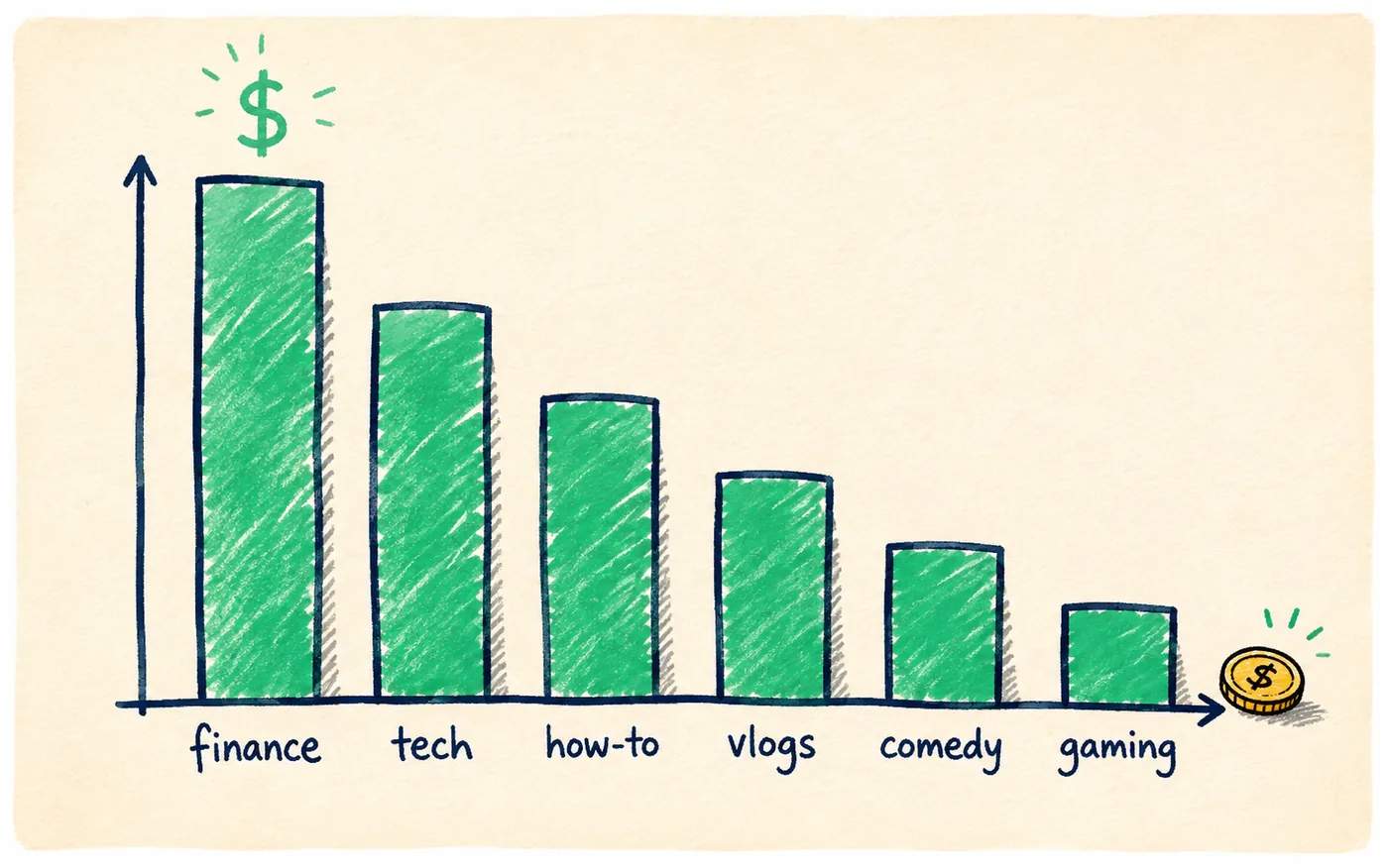
Your niche is the single biggest factor, because it decides how much advertisers will pay to reach your viewers. A finance channel's audience is worth far more to advertisers than a meme channel's. Read the table by the last column: the RPM follows the buying power, not the view count.
| Niche | Typical long-form RPM | Why |
|---|---|---|
| Finance / business | $8–$20+ | High-value advertisers, buyers |
| Tech / software | $5–$15 | Expensive products advertised |
| Education / how-to | $4–$10 | Strong intent audiences |
| Real estate / legal | $4–$12 | Big-ticket local advertisers |
| Lifestyle / vlogs | $2–$6 | Broad but general audience |
| Entertainment / comedy | $1–$4 | High views, lower ad value |
| Gaming | $1–$4 | Younger audience, lower CPMs |
The gap between the top and bottom row is roughly 10x for identical effort and identical view counts. That doesn't mean you should abandon gaming for finance, but it does mean a gaming channel needs a plan beyond ads, and a finance channel can survive on a fraction of the views.
Treat these as ranges
RPM shifts month to month with the ad market (it spikes in Q4, dips in January) and varies by your exact content. Your own YouTube Studio RPM is the only figure that's truly yours.
What 1,000, 100,000 and a million views actually pay
Most people searching for a per-1,000 figure are really trying to answer a bigger question: what would my last video have earned? Here's the same RPM math scaled up, using a mid-range $3 RPM for long-form and $0.03 for Shorts.
| Views | Long-form at $3 RPM | Shorts at $0.03 RPM |
|---|---|---|
| 1,000 | About $3 | About 3 cents |
| 10,000 | About $30 | About 30 cents |
| 100,000 | About $300 | About $3 |
| 1,000,000 | About $3,000 | About $30 |
| 10,000,000 | About $30,000 | About $300 |
Two things jump out. First, long-form and Shorts aren't in the same conversation financially. Second, a million views is a life-changing event for your channel's growth and a fairly ordinary month's income for a working professional. Plan accordingly.
Shorts pay much less than long-form
If you're asking about Shorts specifically, brace yourself. Shorts monetize through a separate, much smaller pool, because a quick swipe shows far fewer ads than a 10-minute video, and that pool is split across every Short on the platform.
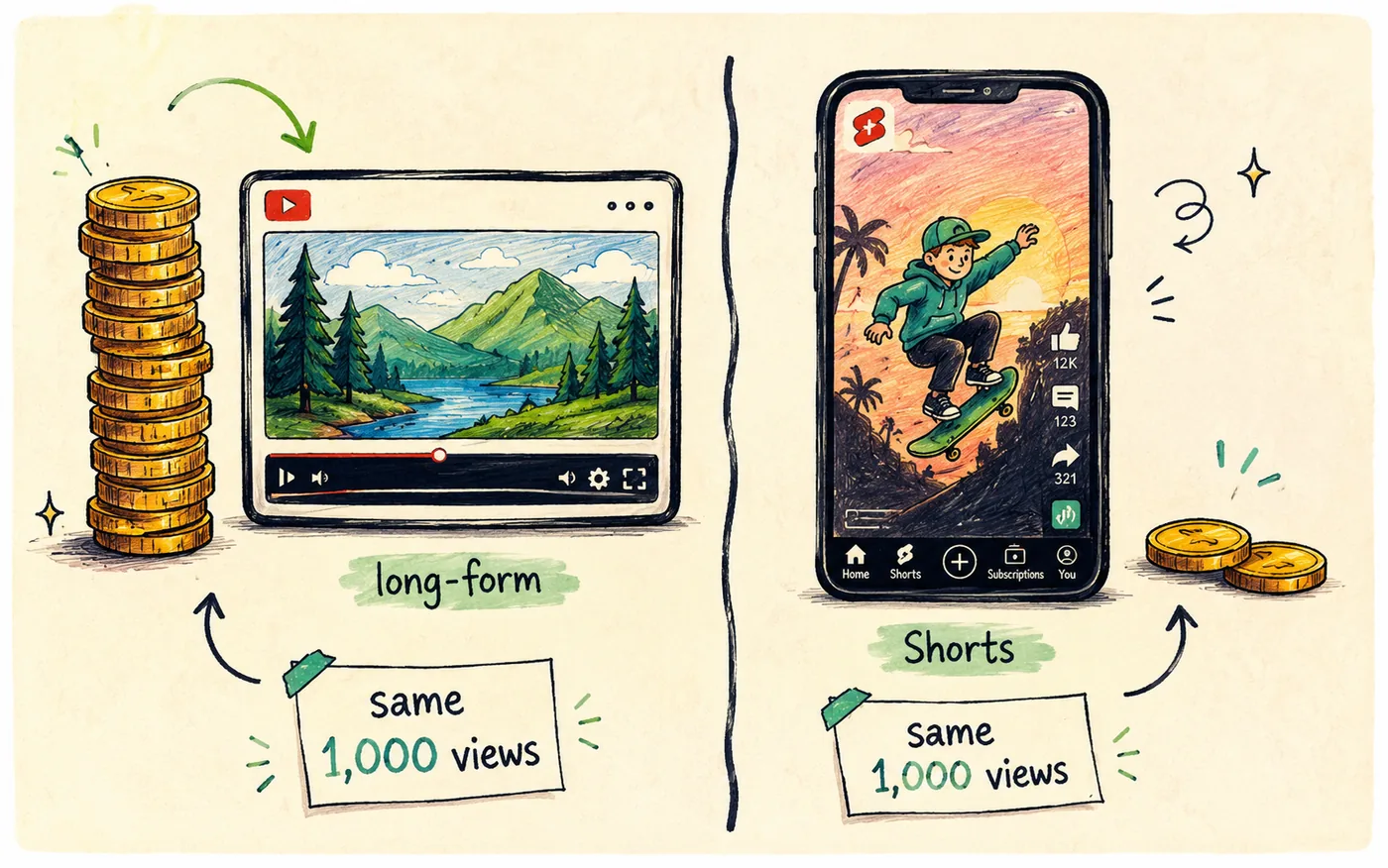
- Shorts RPM usually lands around $0.01–$0.06 per 1,000 views, a few cents rather than a few dollars.
- A viral Short with 1,000,000 views might earn roughly $10–$60 from the Shorts pool.
- The value of Shorts is reach and subscribers, not direct pay. Use them to feed viewers to monetized long-form.
- The same vertical clip also earns on TikTok and Reels, so the smart move is to stop treating a Short as a YouTube-only asset.
That last point is the one worth acting on. A Short costs you nothing extra to publish on three more platforms, and each platform runs its own payout pool. If you're only uploading vertical video to YouTube, you're leaving the other pools untouched. That's the whole argument behind posting one clip to every platform at once.
Why your views don't all earn money
Raw views and monetized views aren't the same. Several filters shrink the number that actually pays, and understanding them explains most of the gap between what you expected and what showed up.
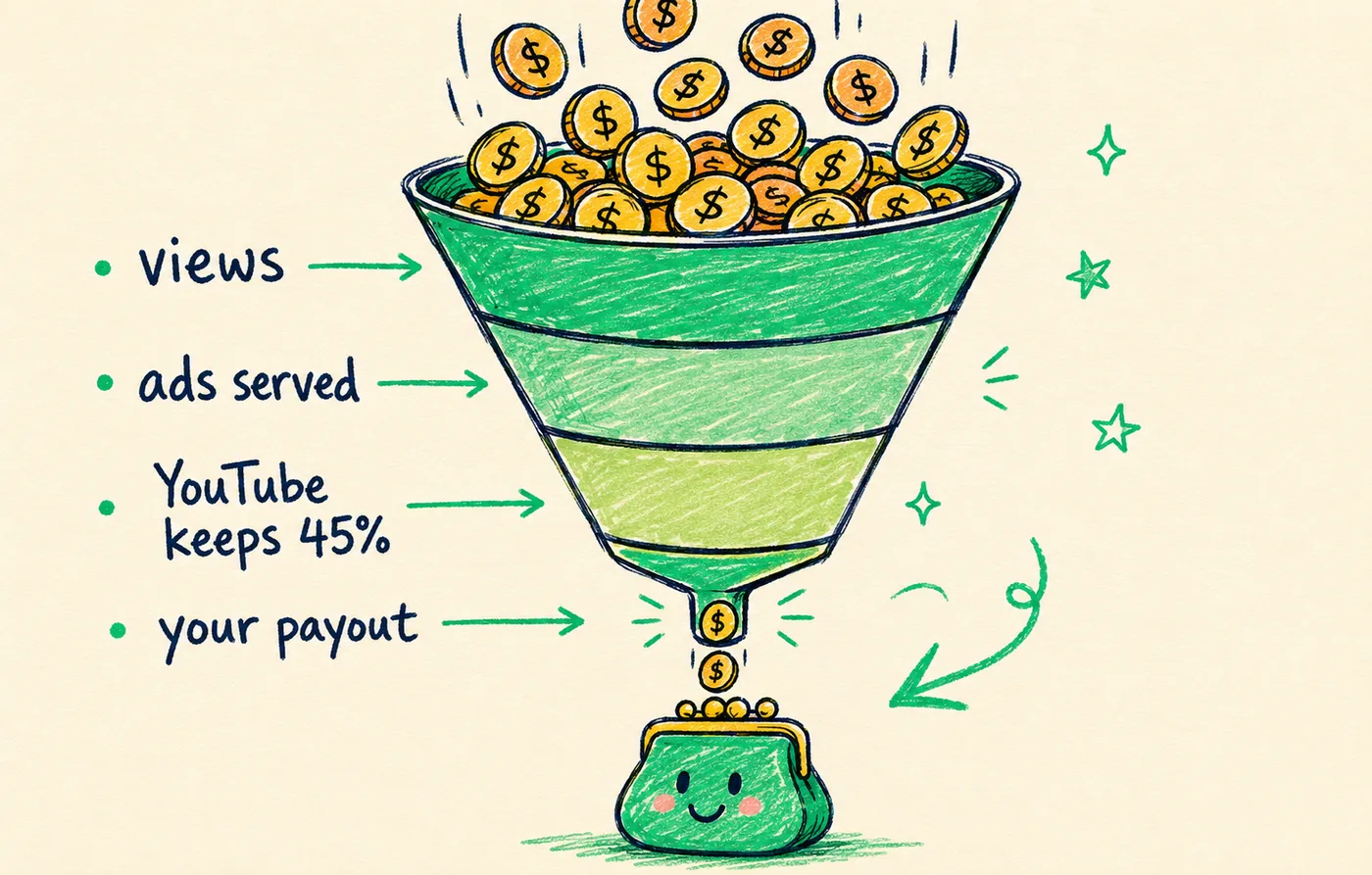
- 1Not every view gets an ad. Some viewers see none, some use ad blockers, some watch too briefly for a pre-roll to matter.
- 2Ad type matters. A skippable ad someone skips pays little; a completed or non-skippable ad pays more.
- 3YouTube takes 45% of the long-form ad revenue before your share.
- 4Your RPM averages all of it, monetized and unmonetized views together, which is exactly why it always looks lower than the CPM.
A monetized-view rate of 50–70% is normal. If yours is much lower, check whether a chunk of your traffic is Shorts, whether videos are getting limited ads for advertiser-unfriendly content, and whether your audience skews toward heavy ad-blocker use.
A worked example: what a real video earns
Numbers feel abstract until you run them on a real video, so let's do that. Say you post a 12-minute how-to video in the education niche and it gets 50,000 views over its first month.
- 1Views: 50,000 total. But maybe 60% are monetized (ads actually served), so call it 30,000 monetized views.
- 2CPM: advertisers pay, say, $12 per 1,000 ad impressions in your niche.
- 3Gross ad revenue: roughly 30,000 ÷ 1,000 × $12 = $360 before YouTube's cut.
- 4Your 55% share: about $198.
- 5Your RPM: $198 ÷ 50 (thousands of total views) = about $3.96 per 1,000 views.
That $3.96 RPM is the number you'd actually see in YouTube Studio. Notice how the headline CPM of $12 shrank to a real RPM under $4 after unmonetized views and YouTube's split. This is why CPM figures you read online always sound higher than what lands in your account.
Run your own math
Take your monetized-view percentage and niche CPM from YouTube Studio, multiply, take 55%, and divide by your total views in thousands. That's your true RPM, and it beats any estimate in an article, including this one.
When your RPM is highest (and lowest)
Ad rates aren't flat across the year. Advertiser budgets swing, and your earnings swing with them, even if your views stay identical. Watch the middle column: the same video can be worth double depending on the month it lands in.
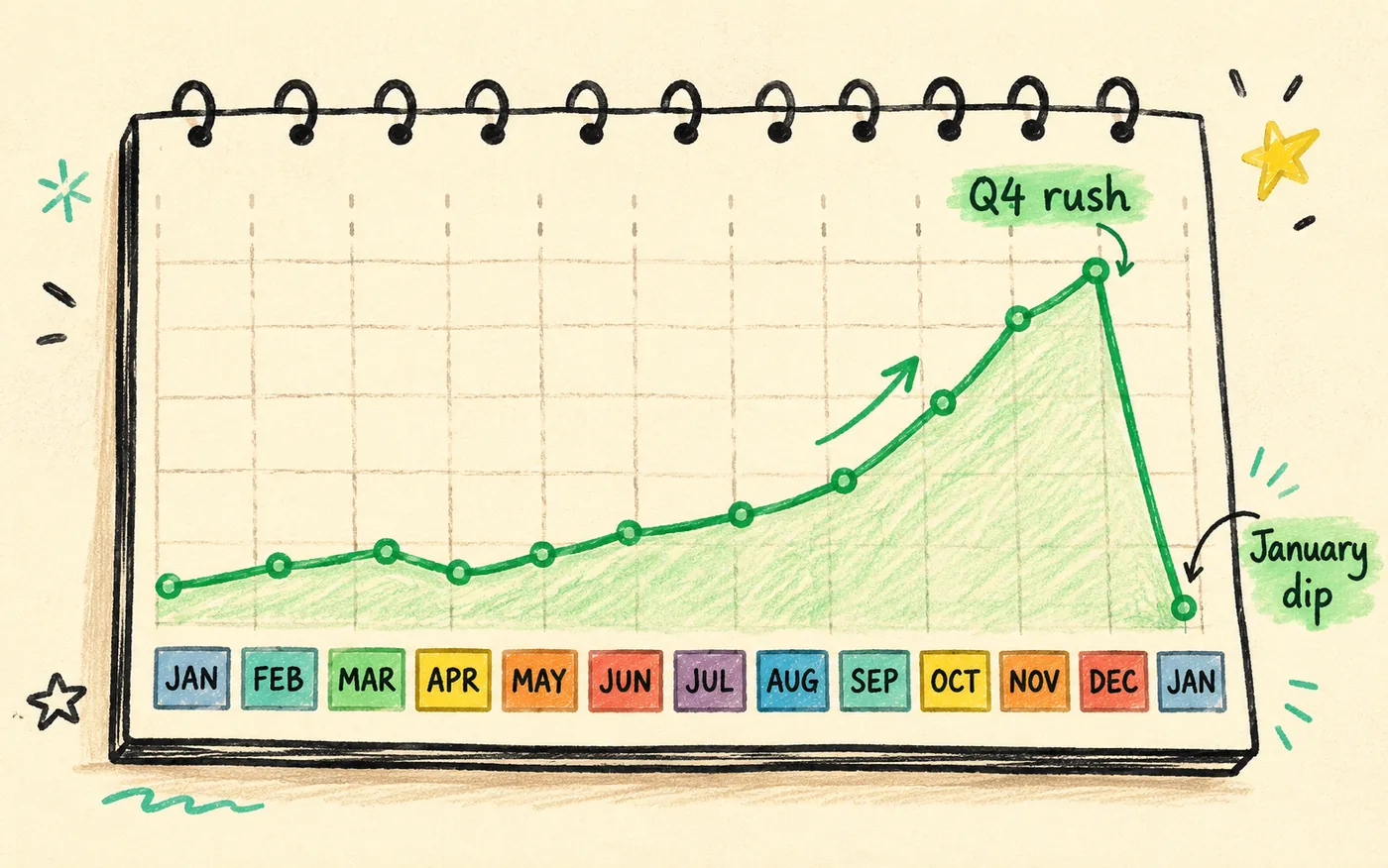
| Period | RPM effect | Why |
|---|---|---|
| Q4 (Oct–Dec) | Highest | Holiday ad budgets peak |
| January | Lowest | Budgets reset, advertisers pull back |
| Spring (Mar–May) | Recovering | Budgets restart, demand climbs |
| Summer | Slightly up | Some seasonal spend |
| Rest of year | Baseline | Steady demand |
The practical takeaway: don't panic if your RPM craters in January. It's the calendar, not your channel. And a viral video in December is worth noticeably more than the same video in the new year, which is a decent reason to hold your strongest upload for Q4 if timing is flexible. Publishing time within the day matters far less than people think, but if you want the evidence, see the best time to post on social media.
Why audience country changes everything
Two channels with identical view counts can earn wildly different amounts based purely on where their viewers live. Advertisers pay far more to reach some countries than others, and that flows straight into your RPM.
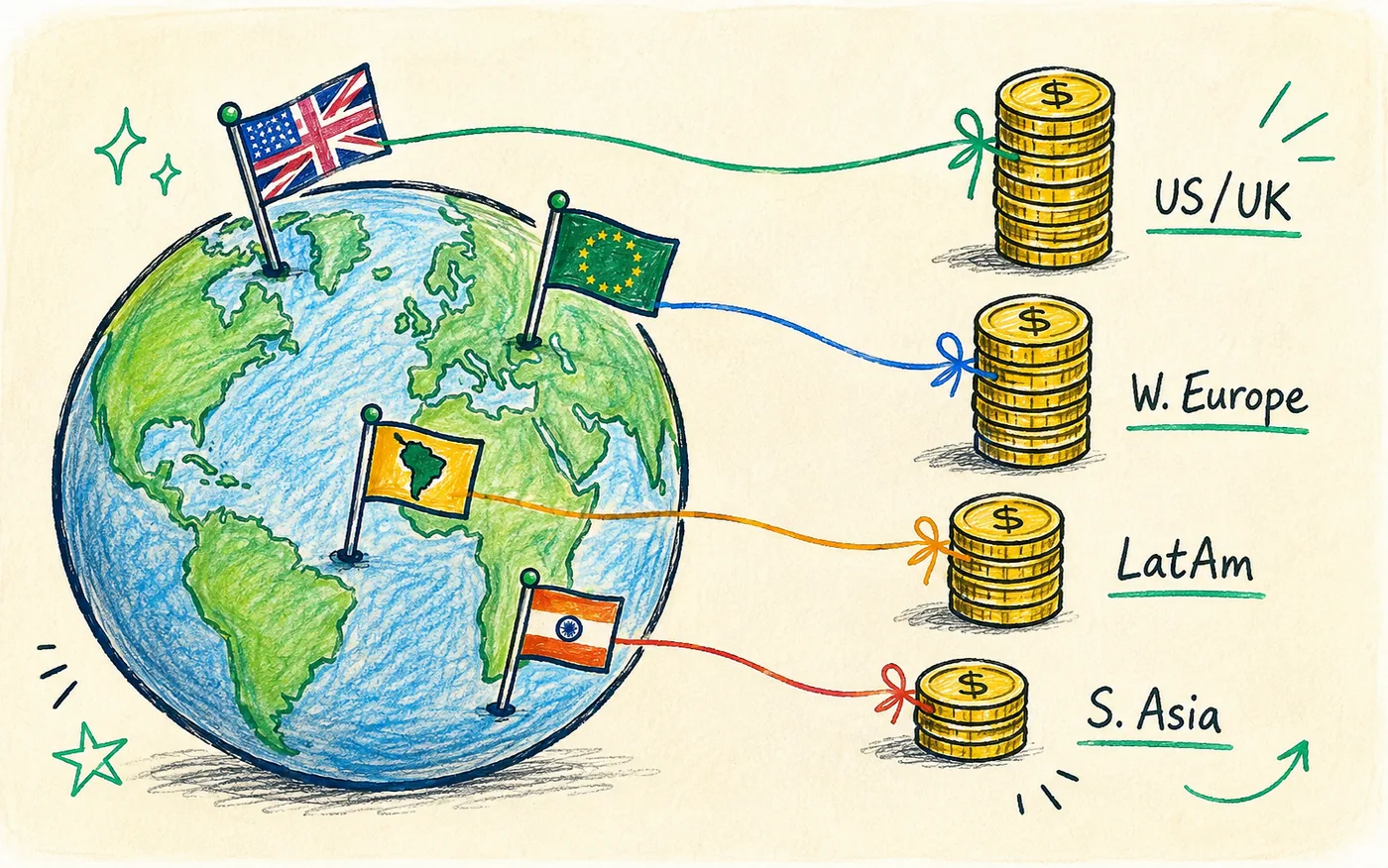
| Audience region | Relative ad value | Effect on RPM |
|---|---|---|
| US, UK, Canada, Australia | Highest | Top-tier RPM |
| Western Europe | High | Strong RPM |
| Gulf states, Japan, Korea | High | Strong RPM in the right niche |
| Eastern Europe, Latin America | Medium | Moderate RPM |
| South & Southeast Asia | Lower | Lower RPM at same views |
This is why the same video can pay $5 per 1,000 views for one creator and under $1 for another. It's not the content, it's the advertiser value of the audience. You can nudge this by making content in English and on topics that attract high-value viewers, but you can't fully control who watches.
The India question
A common search is how much YouTube pays for views in India specifically. Because ad rates there are lower, RPM often lands well under $1 for a general audience. A niche like tech or finance, or an audience that includes overseas viewers, can push it several times higher. The niche and viewer mix matter more than the country label alone.
How to raise your RPM
You can't set your rate, but you can influence the factors that drive it. These are ordered roughly by how quickly they show up in your earnings.
- Make longer videos (8+ minutes) so you can run mid-roll ads, which lift RPM more than any other single change.
- Lean into high-value topics where it fits your channel. A gaming channel that reviews hardware picks up tech advertisers.
- Grow watch time, since longer sessions mean more ad slots and better recommendations.
- Attract audiences in high-CPM countries with your language, thumbnails and topic choices.
- Check your limited-ads warnings. Videos flagged as advertiser-unfriendly run fewer ads, and creators often don't notice for months.
- Diversify beyond ads. The biggest earners add sponsorships, affiliates, and their own products, often worth more than AdSense.
And the compounding move: don't rely on YouTube alone. Cross-post your Shorts to TikTok and Reels so each clip earns reach on three platforms instead of one. The mechanics are covered in how to cross-post to multiple platforms, and the per-platform differences in TikTok vs YouTube Shorts vs Reels.
Turn one Short into reach on YouTube, TikTok and Reels at once with Crossposting.
Try it freeHow YouTube pay compares with TikTok, Reels and Facebook
YouTube gets called the best-paying platform, and for long-form that's true by a distance. The picture changes completely once you compare short vertical video, where every platform runs its own pool. Compare the middle column across rows, not the headline names.
| Platform | Rough pay per 1,000 views | Best used for |
|---|---|---|
| YouTube long-form | $1–$5+ | Actual ad income |
| YouTube Shorts | $0.01–$0.06 | Reach into your long-form |
| TikTok Creator Rewards | $0.40–$1.00 (qualified) | Direct short-form pay |
| Facebook Reels | Varies by bonus terms | Extra pool for the same clip |
| Instagram Reels | No general per-view pay | Brand deals and audience |
The conclusion isn't "pick the best payer." It's that the same vertical clip can collect from several of these at once, which is why the ranking question is really a distribution question. The full breakdown lives in which platform pays creators the most, with the deeper numbers in what TikTok pays for a million views, what Facebook Reels pays per 1,000 views and how much Instagram pays.
What to do before you're monetized
None of these numbers apply until you're in the YouTube Partner Program, which needs 1,000 subscribers plus either 4,000 valid public watch hours in twelve months or 10 million Shorts views in ninety days. Most people reading an RPM article are still under that bar, and the honest advice for that stage is different.
Stop optimizing for RPM and optimize for volume and consistency. The threshold is a watch-time problem, and watch time comes from publishing enough videos that one of them finds an audience. Creators who cross the bar usually do it on the back of two or three videos that outperformed everything else, and they had no idea which ones those would be when they hit upload.
The exact requirements and payout timeline are covered in when YouTube starts paying you. While you're waiting, the fastest way to accelerate is to stop making YouTube-only content: batch your filming, cut each session into several clips, and publish everywhere. Repurposing one recording into a week of posts is how small channels manufacture the volume that gets them over the line.
Mistakes that quietly cost you RPM
Most RPM problems aren't dramatic. They're small habits that shave a percentage off every video for months before anyone checks.
- Uploading everything at 7:59. A video just under eight minutes runs no mid-rolls. Ninety extra seconds of real content changes the payout structure.
- Ignoring the yellow icon. Limited-ads flags cut your ad load. Request review when the video deserves it instead of shrugging.
- Letting Shorts dominate your view mix. Your channel RPM is an average, so a flood of Shorts views drags the headline number down even when long-form is doing fine.
- Chasing broad viral topics that pull in an audience advertisers don't value, then wondering why a big month paid badly.
- Judging a video in week one. YouTube keeps serving good videos for months, and the RPM on the long tail is often better than the launch spike.
If your views themselves are the problem rather than the rate, that's a different diagnosis. The reach troubleshooting playbook for short-form starts with why your TikTok isn't getting views, and most of it applies to Shorts unchanged.
Beyond AdSense: the income that actually scales
Here's the part that reframes the whole question. For most established creators, ad revenue is the smallest slice of their YouTube income. The channel is the storefront. The money is what it sells.

- Sponsorships: a single integrated brand deal on a mid-sized video can pay more than a month of AdSense.
- Your own products: courses, memberships, and digital products carry no per-view ceiling and no revenue split.
- Affiliates: recommending tools you actually use can out-earn ads in high-intent niches.
- Channel memberships and Super Thanks: recurring income directly from your most engaged viewers.
This is why chasing RPM alone is a trap. A channel with a modest RPM but a $200 course can out-earn a higher-RPM channel with nothing to sell. Views are the top of a funnel, and AdSense is just the first, smallest payout along it.
How to actually increase your YouTube income
Since you can't set your rate, focus on the levers that compound. In rough order of impact for most channels:
- 1Add a product or service. The single biggest jump in creator income comes from having something to sell, not from a higher RPM.
- 2Land sponsorships once you have consistent viewership, often the second-largest stream.
- 3Make longer videos (8+ minutes) to unlock mid-roll ads and lift RPM.
- 4Grow total views by cross-posting Shorts to TikTok and Reels, funneling new audiences to your channel.
- 5Lean into high-value topics where they fit your channel authentically.
The operational trick that makes all five possible is batching. Film once, cut several clips, and queue them across every platform in one sitting instead of uploading by hand every day. Content batching and scheduling posts in advance are what turn a good month into a repeatable system.
Ad revenue is the floor, and it's a fine floor to build on. But the creators earning real money treat views as attention to convert, then build the products, sponsorships, and cross-platform reach that turn that attention into income.
Frequently asked questions
How much does YouTube pay for 1,000 views?
Most long-form creators earn roughly $1–$5 per 1,000 views (RPM), with finance and tech niches reaching $8–$20 or more. Shorts pay far less, around $0.01–$0.06 per 1,000 views. There's no fixed rate, because YouTube shares ad revenue rather than paying per view, so it depends on niche, audience country, and ad formats.
How much does YouTube pay for 1 million views?
For long-form, roughly $1,000–$5,000 for a typical channel, and considerably more in high-CPM niches like finance or software. For Shorts, a million views usually earns only about $10–$60 from the Shorts pool. Your actual RPM in YouTube Studio is the real figure, and it's the only one worth planning around.
Why is my YouTube RPM so low?
Common causes: a low-CPM niche, a young or non-US audience, videos under eight minutes with no mid-roll ads, limited-ads flags you haven't appealed, or a high share of Shorts views dragging the average down. Longer videos, higher-value topics, and audiences in high-CPM countries all raise RPM.
Do YouTube Shorts pay well?
Not directly. Shorts earn only a few cents per 1,000 views from a separate pool. Their real value is reach and subscribers. Use Shorts to grow an audience and funnel viewers to monetized long-form, and post the same vertical clip to TikTok and Reels so it earns from more than one pool.
How many views do you need to make $1,000 on YouTube?
At a typical $3 RPM you'd need roughly 330,000 long-form views. In a finance or software niche at $10 RPM, about 100,000 views does it. On Shorts at $0.03 RPM, you'd need somewhere around 33 million views, which is the clearest illustration of why Shorts are a growth tool rather than an income stream.
When does YouTube actually pay you?
YouTube pays monthly through AdSense, around the 21st to the 26th, for revenue earned in the previous month, and only once your balance passes the $100 payment threshold. You also need to be in the Partner Program with 1,000 subscribers plus 4,000 watch hours or 10 million Shorts views to earn anything at all.
Does watching your own video make money?
No. YouTube filters invalid traffic, and repeated self-views, view bots or paid view services get stripped out and can cost you monetization entirely. The safe version of the same instinct is distribution: publish the clip to other platforms where it can find genuinely new viewers.
Bottom line
YouTube pays roughly $1–$5 per 1,000 long-form views for most creators, more in finance and tech, and only cents per 1,000 on Shorts. There's no fixed rate. Your RPM depends on niche, audience country, video length, watch time, and ad formats, and it moves with the ad market every single month.
So treat RPM as a floor you slowly raise, not a number you optimize your life around. Make longer videos, keep your Shorts working on three platforms instead of one, and build something to sell to the audience they bring. Try Crossposting free.
Put this into practice
Schedule a week of content to every platform in one sitting. Free to start, no card today.
Try Crossposting free