Which Social Media Platform Pays Creators the Most? (2026)
A clear ranking of what each platform pays creators, and why the top earners refuse to pick just one.
The Crossposting Team
Crossposting.xyz
YouTube pays creators the most per view. Long-form videos earn roughly $1 to $5 per 1,000 views, and far more in finance or software, which puts it an order of magnitude above every short-form platform. That's the clean answer to the question as it's usually asked.
It's also close to useless on its own, because direct per-view pay is the smallest slice of what full-time creators earn. This guide ranks the platforms honestly, shows what the ranking hides, and explains why the people making real money stopped choosing between platforms years ago.
The ranking: direct pay per view
Counting only what each platform pays you for views, the order barely changes from year to year.
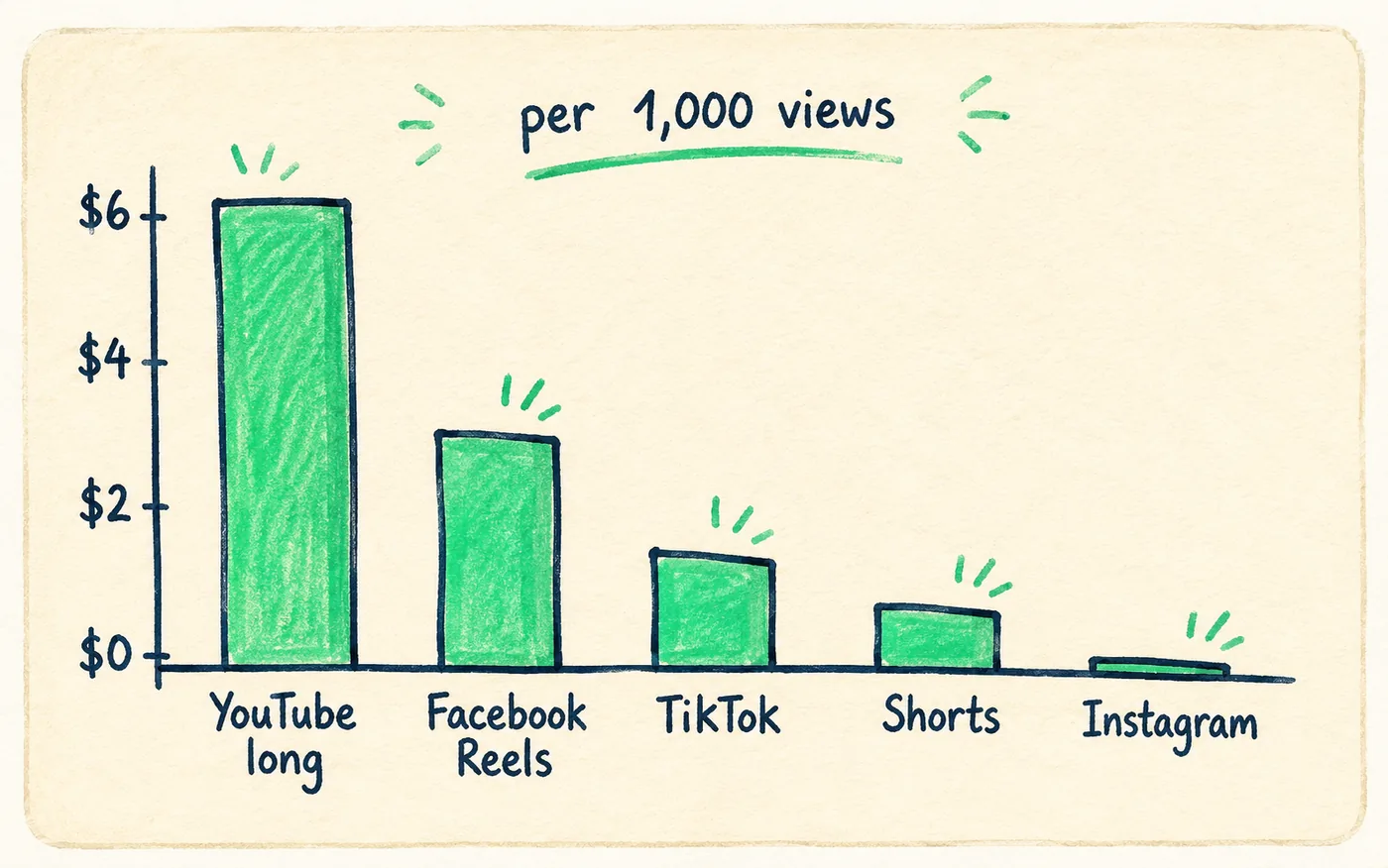
| Platform | Rough pay per 1,000 views | Notes |
|---|---|---|
| YouTube (long-form) | $1 – $5 (up to $20 in finance) | Highest per view, 55% ad share |
| Facebook Reels | $0.01 – $2+ | Ad-revenue share, audience-dependent |
| TikTok Creator Rewards | $0.40 – $1 (qualified views) | Needs 10k followers, 1min+ videos |
| YouTube Shorts | $0.01 – $0.06 | Small pool, excellent for reach |
| X (Twitter) | Varies, subscriber-gated | Ad share for verified accounts |
| Mostly $0 direct | Pays through bonuses and deals | |
| Pinterest, LinkedIn, Threads | $0 direct | Traffic and clients, not payouts |
Two things jump out. First, the gap between the top and bottom of that table is roughly a hundred to one for the same view count. Second, three of the platforms most creators spend the most time on pay nothing directly at all.
These are brackets, not quotes
Every figure moves with niche, audience country and the ad market. The detailed breakdowns live in what YouTube pays per 1,000 views, what TikTok pays for a million views and what Facebook Reels pay.
Why per-view pay is the wrong question
Ask a creator who does this full time where their money comes from and almost none of them lead with ad revenue. Most treat it as a bill payment that shows up monthly and gets ignored.
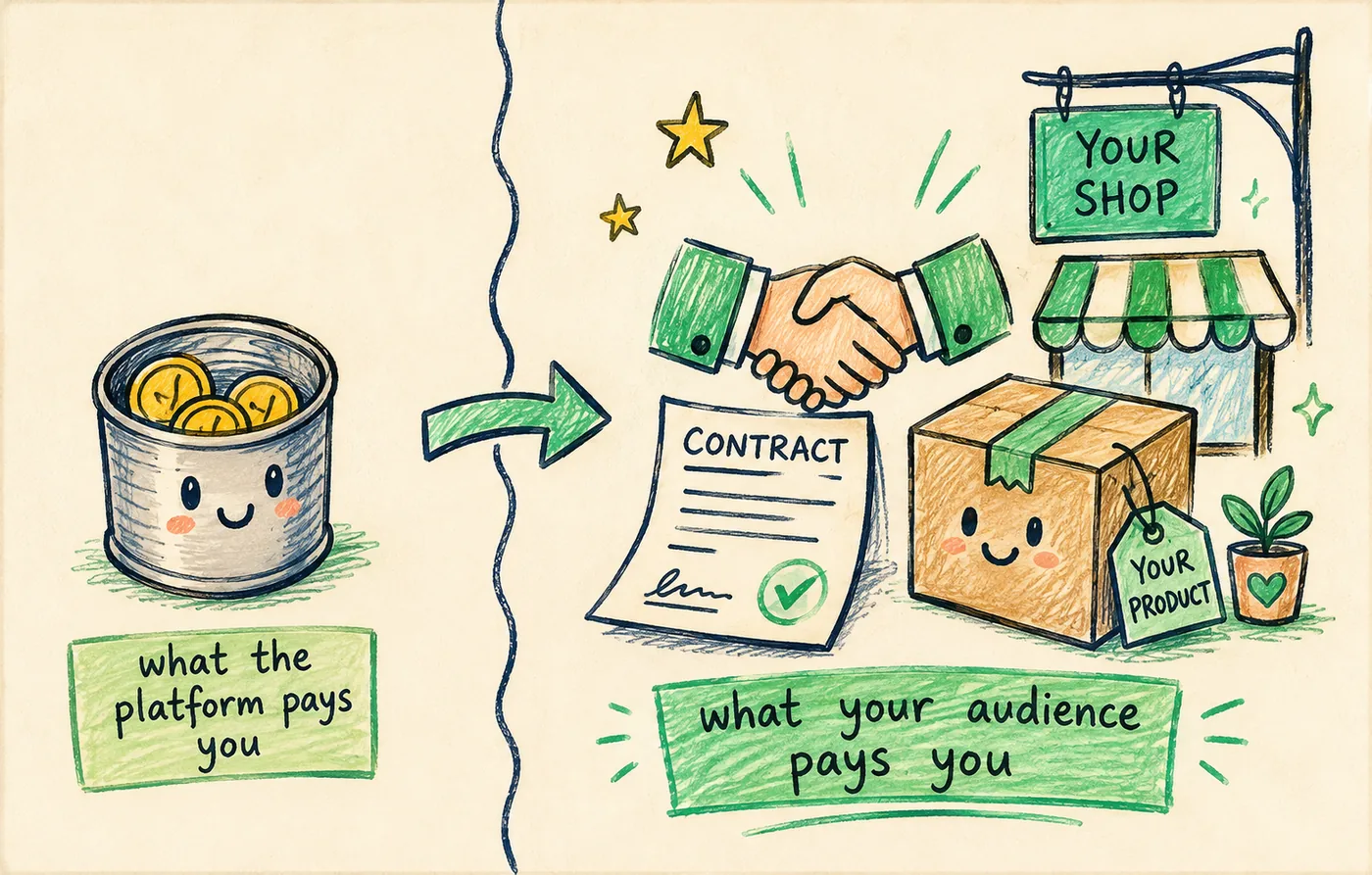
- Brand deals routinely pay more for one video than a million organic views would earn from any platform's ad share.
- Your own products — courses, memberships, merch, software, templates — have no per-view ceiling and no algorithm between you and the sale.
- Affiliate and shop commissions scale with how much people trust you, which is why small engaged audiences beat big passive ones.
- Email and community turn borrowed attention into an audience you actually own, and survive any algorithm change.
So the real question isn't which platform pays the most. It's which platform builds the audience that unlocks those four. For most creators the answer is a combination: short-form for reach, YouTube and their own channels for revenue.
What creators actually earn from
Income mix shifts as an audience grows. This is roughly how it breaks down for a mid-sized creator doing this seriously, and the shape matters more than the exact percentages.
| Income stream | Rough share of income | What it scales with |
|---|---|---|
| Brand deals | 40 – 60% | Audience trust and niche value |
| Own products | 15 – 35% | Depth of relationship |
| Affiliate and commissions | 10 – 20% | Recommendation credibility |
| Platform ad share | 5 – 20% | Raw views and viewer country |
Read the bottom row again. The thing everyone argues about online is the smallest line in the budget for most working creators. It matters enormously at the very start, when it's the only money coming in, and shrinks steadily as everything else grows.
The platform-by-platform reality
YouTube: best for direct income
Highest pay per view by a wide margin, plus memberships, Super Thanks and the strongest gravitational pull for sponsorships. The catch is that YouTube is the hardest platform to grow on, and the slowest. You'll wait months for traction that TikTok might hand you in a week, and the requirements to start earning at all are strict enough that when YouTube starts paying you is its own question.
TikTok: best for reach, thin on direct pay
Nothing grows an audience faster from zero. The Creator Rewards program is real money but it behaves like a bonus, not a salary, and it's gated behind follower counts and video length rules. Use the reach, monetize elsewhere, and expect volatility. If your views collapse overnight, that's normal enough to have its own troubleshooting guide in why your TikTok isn't getting views.
Instagram: best for brand deals
Direct per-view pay is essentially zero, which makes the platform look terrible on the table above and much better in a bank account. Instagram is where sponsorships get negotiated, especially in beauty, fitness, food, travel and lifestyle, and DMs from brands land there more than anywhere else. The full picture is in how much Instagram actually pays.
Facebook: the underrated one
Its ad system is mature and its users are older and higher-spending, so Reels there can out-earn TikTok for the right niche. Most creators under 30 skip it out of reflex, which is precisely why it's less crowded.
X, LinkedIn and Pinterest: not payouts, pipelines
X pays a share of ad revenue to verified accounts, and it's modest. LinkedIn and Pinterest pay nothing directly, but LinkedIn converts to clients at rates no other platform touches for B2B, and Pinterest sends traffic to things you own for years after posting. Judging them by RPM misses what they're for.
What each platform pays beyond ads
Ad share is only one of the ways platforms hand creators money, and the extras are where the ranking shuffles. Some platforms with mediocre RPMs have excellent tipping and subscription tools bolted on.
| Platform | Beyond ad share | Worth chasing? |
|---|---|---|
| YouTube | Memberships, Super Thanks, Super Chat | Yes, especially with a loyal core |
| TikTok | LIVE gifts, Series, TikTok Shop | Shop yes, gifts only if you go live |
| Subscriptions, badges, Shop | Deals matter more than any of these | |
| Stars, subscriptions, in-stream ads | Stars are real money in some niches | |
| X | Subscriptions, tips | Only with an unusually loyal following |
Two patterns are worth noticing. Live streaming unlocks money on almost every platform, and it's the single most under-used lever by short-form creators. And selling physical products through a native shop routinely beats every ad program on the same account, because you're capturing a purchase instead of an impression.
How much do you actually need to earn a living?
The abstract comparison gets useful the moment you convert it into a target. Say you want $3,000 a month from your content. Here's roughly what that means per platform if ad revenue is your only stream.
| Route | Monthly views needed | Realistic? |
|---|---|---|
| YouTube long-form at $3 RPM | ~1,000,000 | Hard but common |
| Facebook Reels at $0.50 RPM | ~6,000,000 | Only at real scale |
| TikTok Rewards at $0.60 RPM | ~5,000,000 | Very few accounts |
| YouTube Shorts at $0.04 RPM | ~75,000,000 | Effectively no |
| 30 sales of a $99 product | Whatever it takes to sell 30 | Yes, at small scale |
That last row is the one to sit with. Thirty sales a month is a modest ask for an audience of a few thousand engaged people, and it beats a number of views that most creators will never reach. This is the concrete version of the argument that per-view pay is the wrong thing to optimise, and it explains why creators with 8,000 followers sometimes out-earn ones with 800,000.
The creator income ladder
Most creators move through a rough progression, and where you sit on it decides which answer to "which platform pays most" is correct for you. The advice that's right at the bottom rung is wrong at the top.
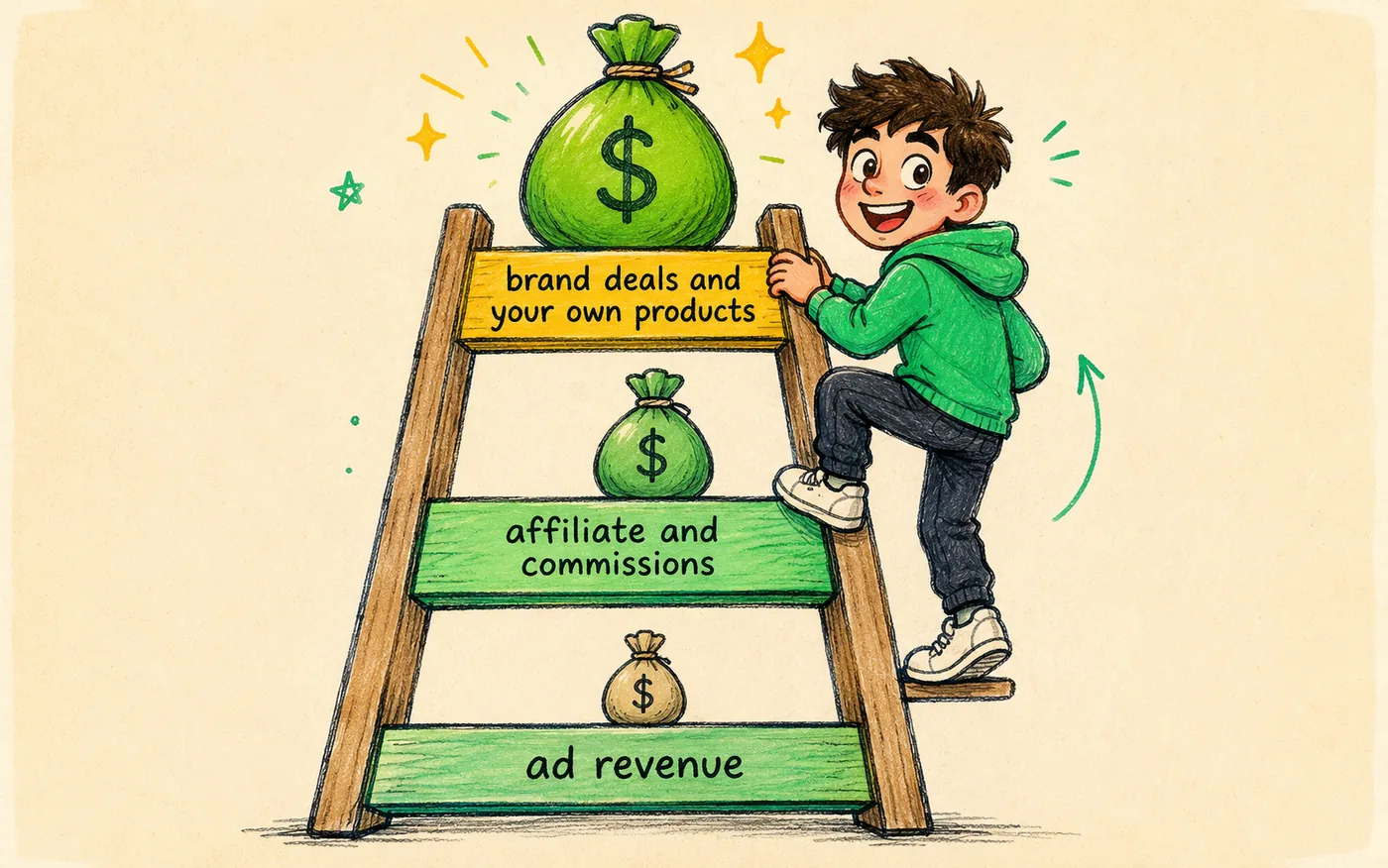
The bottom rung is direct payouts: YouTube ad revenue, TikTok rewards, Facebook ad share. Modest money, but it's the only money, so per-view comparisons genuinely matter here. A new creator asking which platform pays best per view is asking the right question for their situation.
The middle rung is affiliate and commission income. This scales with trust rather than raw reach, which is the first point where a smaller audience can out-earn a larger one. The platform that builds the tightest relationship with viewers starts to matter more than the one with the best RPM, and that reshuffles the ranking completely.
The top rung is brand deals and your own products, where serious creator income lives. There's no per-view ceiling. One sponsorship or one course launch can beat a year of ad revenue. At this level platforms are audience-building tools and nothing else, and asking which one pays most per view is like asking which of your shoes is fastest.
Why the top earners refuse to pick one
The creators making the most treat platforms as a portfolio rather than a bet. One clip goes everywhere, each platform contributes a slice, and the total is bigger than any single source could be even if they'd chosen perfectly.
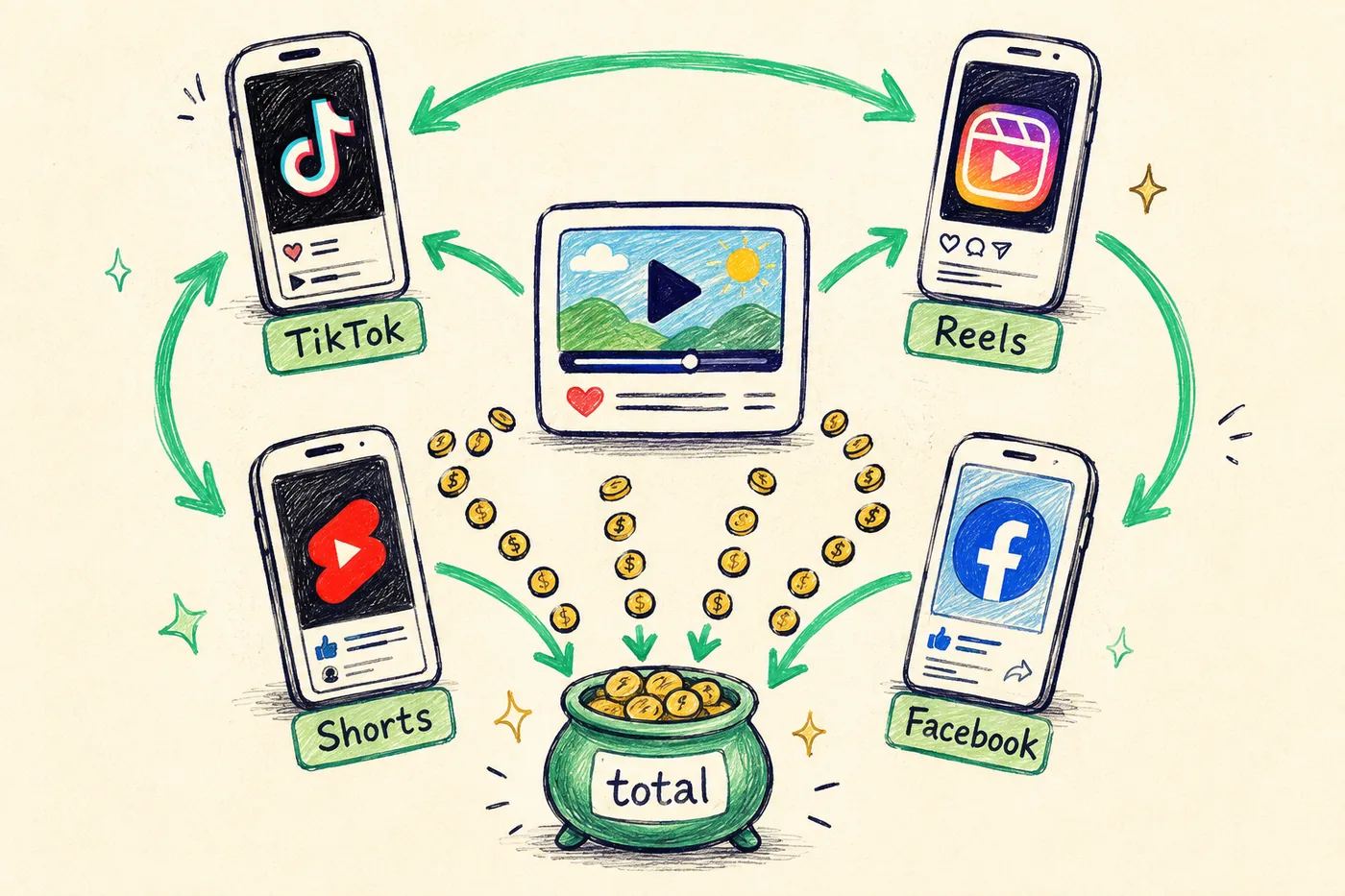
Run the arithmetic on a single clip that gets 100,000 views on each of four platforms. YouTube Shorts might pay $4, TikTok $60, Facebook $40 and Instagram nothing. Individually those are all disappointing numbers. Together they're $104 from one upload, plus 400,000 people who now know your name, some of whom buy things.
The other half of the argument is that you cannot predict the winner. View counts follow a power law, and the same clip that dies on TikTok can do 2 million on Shorts for reasons nobody can explain afterward. Posting to one platform buys one lottery ticket. That's the entire case behind posting the same content everywhere at once.
Audience value beats platform choice
Here's the factor that outranks every row of the ranking table: who is watching. The same platform pays wildly different rates depending on your viewers' country and how much advertisers want to reach them.
| Audience | Effect on pay | Example |
|---|---|---|
| US, UK, CA, AU viewers | 3 – 10x baseline | Highest advertiser bids |
| Western Europe | 2 – 5x baseline | Strong, slightly behind US |
| Low-CPM markets | Baseline or under | Thin ad demand |
| Finance, SaaS, insurance niche | 3 – 20x baseline | Advertisers with budget |
| Entertainment, memes | Baseline | Big reach, low bids |
A finance creator on TikTok can out-earn a meme creator on YouTube. Niche and geography swamp platform choice, which is why two people can give you opposite advice about the same platform and both be right about their own accounts.
So what should you actually lead with?
Pick by goal, not by RPM table. One of these four will describe you.
- 1You want direct income soon. Prioritize YouTube long-form. It's slow and it's hard, and it's still the only place where views alone reliably pay a bill.
- 2You want growth fast. Lead with TikTok and Reels, then funnel the audience toward YouTube and your email list. The tactics are in how to grow on TikTok from zero.
- 3You want brand deals. Build on Instagram and TikTok, keep a tidy media kit, and treat engagement rate as the metric that matters more than followers.
- 4You want the most total income. Post everywhere and stack the streams. This is the honest answer for most people reading this.
Whatever you lead with, don't publish to only one. The same vertical video works on all of them with no extra edit, which is the whole premise of cross-posting to multiple platforms.
The workload objection, and the answer to it
The standard pushback is that being on five platforms is five times the work, and done manually that's true. Export, open app, upload, rewrite the caption, fix the cover, switch accounts, repeat. An hour per clip, every clip. Nobody sustains it, which is why most creators quietly collapse back to one platform by week three.
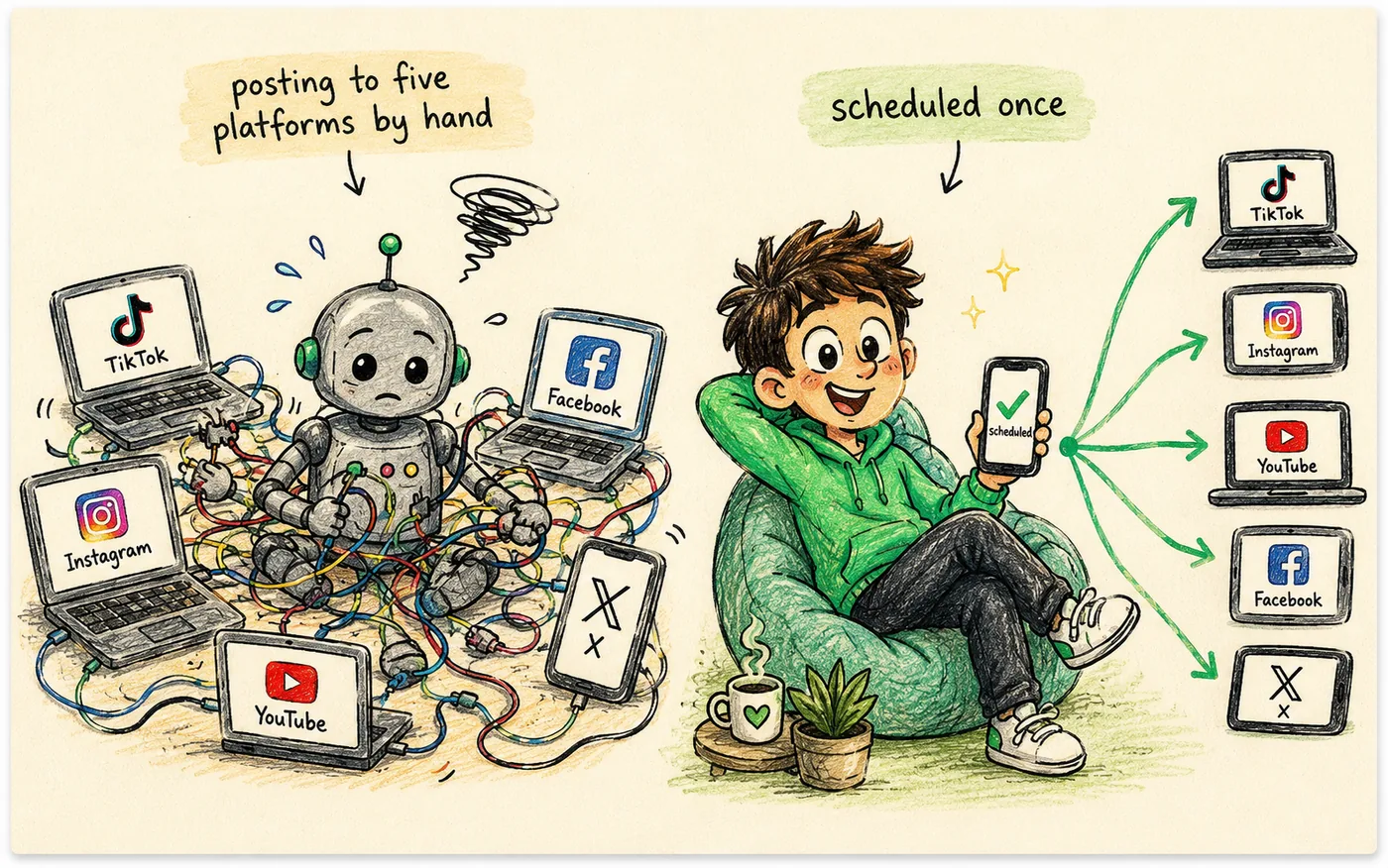
Scheduled properly, the marginal cost of the fourth and fifth platform rounds to zero. One upload, one caption, tick the boxes, done. The content was always the expensive part, and you already paid for it. A scheduler built for creators turns the five-platform question from a workload decision into a checkbox.
The same logic applies to volume. Once distribution is free, batching a week of clips in one sitting is the highest-leverage habit available to you, and content batching is how most consistent creators actually produce.
Post one clip to every platform at once and let each one pay you. Free to start.
Try it freeThe mistakes that cap creator income
Most stalled creator incomes trace back to the same handful of decisions, none of which are about picking the wrong platform.
- Waiting for a threshold before monetizing anything else. You can sell a product or take an affiliate deal at 300 followers. Ad revenue is the only stream with a gate.
- Chasing views in a niche nobody advertises against. Ten million entertainment views can pay less than fifty thousand finance views.
- Building on one platform only, so a single algorithm change or ban takes the entire business with it.
- Never asking the audience to do anything. No email list, no product, no link. Pure attention that never converts to anything you own.
- Optimising the wrong number. Follower count is vanity. Watch time, email subscribers and revenue per thousand views are the three that pay.
Fixing the last one usually fixes the others by accident, because you start making different content once you're measuring different things.
How to build the stack in practice
The system underneath a diversified creator income is not complicated. It's four steps that most people do in the wrong order.
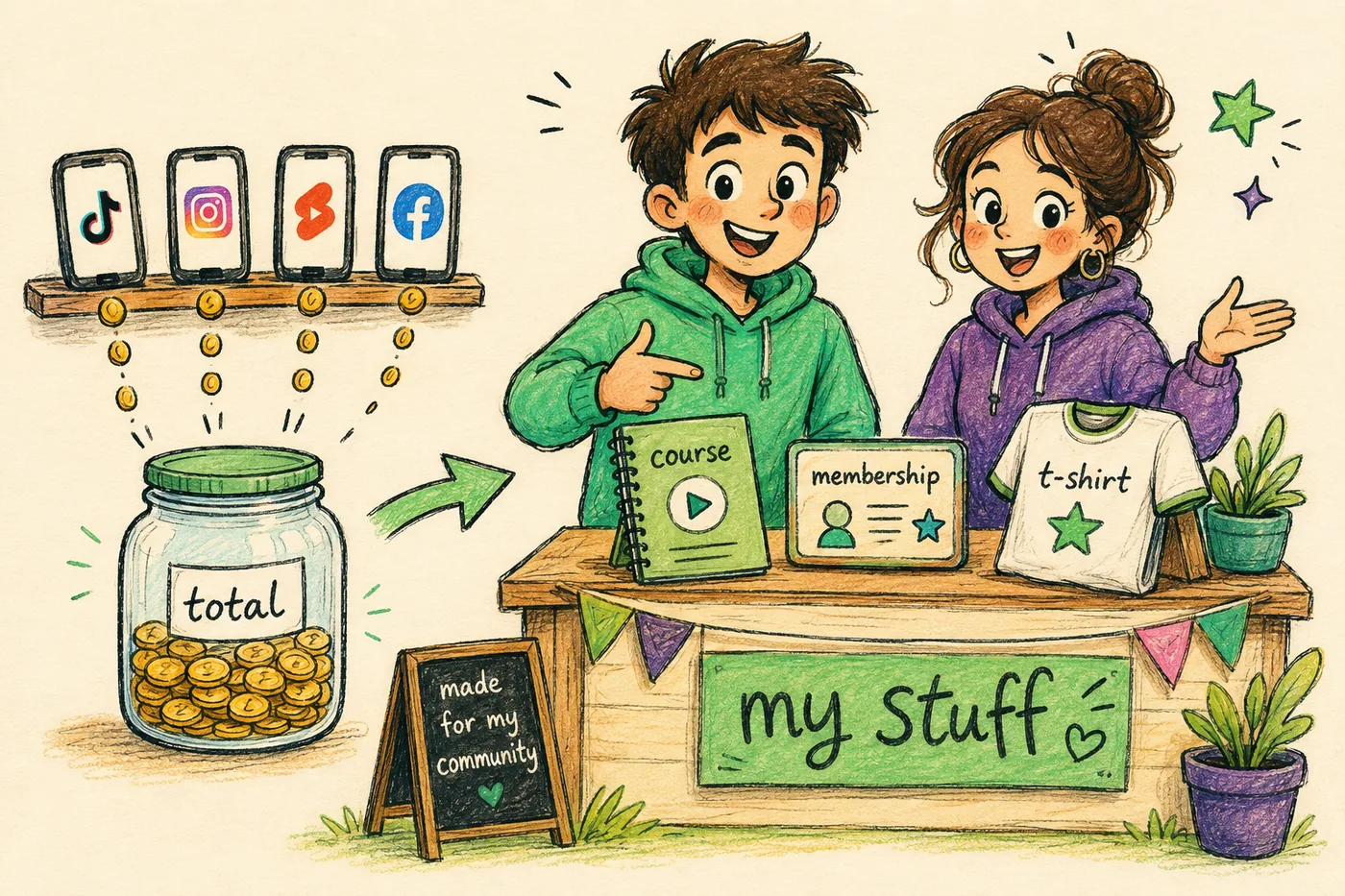
- 1Make the content once, at your natural quality bar, in 9:16 with captions burned in so it's native everywhere.
- 2Distribute it everywhere automatically, so each platform contributes its slice of ad share from the same effort.
- 3Give the audience somewhere to go — an email list, a community, a product page — before you think you're big enough.
- 4Layer the paid streams on top in order: affiliate first because it needs no infrastructure, then sponsorships, then your own product.
Repurposing multiplies step one. A single long video becomes a dozen clips, and each clip goes to every platform, which is how creators who look prolific are actually working fewer hours than you. The mechanics are in turning one video into ten posts.
Getting paid: the thresholds nobody mentions
Earning and being paid are separate events, and every platform sits on your money until you cross a line. Budget around the delay rather than being surprised by it.
- YouTube pays monthly through AdSense once your balance passes $100, around the 21st of the following month.
- TikTok lets you withdraw from a much lower balance, but rewards for a given day settle over the following weeks rather than instantly.
- Facebook pays monthly with a minimum threshold that has historically sat near $100, roughly three weeks after month end.
- Brand deals pay on invoice terms you negotiate, and net-30 quietly becomes net-60 more often than anyone admits.
- Your own products pay within days through your payment processor, which is the least glamorous and most underrated advantage they have.
Add it up and a first payout typically lands two to three months after the work, on every platform, which is worth knowing before you quit anything. The creators who handle that gap well are the ones who started the affiliate and product streams early, because those pay fastest and don't wait for a threshold.
When focusing on one platform is the right call
The multi-platform argument has a real exception. If you're brand new and still learning what works, spreading across five platforms means five sets of feedback you're not experienced enough to read yet. Pick one, post daily for sixty days, and learn the craft on a single surface.
Focus while you're learning what works. Distribute once you know. The mistake is doing those in the wrong order.
The same applies if your business is genuinely single-platform: a LinkedIn consultant closing clients from one post a week doesn't need TikTok, and a Pinterest-driven shop doesn't need X. Distribution breadth is leverage, not a moral obligation. What it isn't is a thing to postpone forever, and the comparison in TikTok vs YouTube Shorts vs Reels is a reasonable place to decide where to start.
Frequently asked questions
Which social media platform pays creators the most?
YouTube pays the most per view, roughly $1 to $5 per 1,000 long-form views and more in finance or tech. But total creator income depends far more on brand deals, products and affiliates than on direct payouts, which is why the highest earners publish across several platforms at once.
Does TikTok or YouTube pay more?
YouTube pays significantly more per view, especially on long-form video. TikTok grows an audience faster than anything else, but Creator Rewards behave like a bonus rather than a salary. The common pattern is TikTok for reach and YouTube for revenue, using the same clips on both.
Can you make money on Instagram if it doesn't pay per view?
Yes, and plenty of creators earn more there than on platforms that do pay per view. Instagram is the strongest platform for brand deals, affiliate sales and driving traffic to your own products. The income comes from your audience rather than from Meta.
How many followers do you need before you earn anything?
For platform ad revenue, thresholds apply: YouTube needs 1,000 subscribers plus watch time, TikTok Creator Rewards needs 10,000 followers. For affiliate income, products and small sponsorships there is no threshold at all. Creators with a few hundred engaged followers sell things every week.
Should I focus on one platform or several?
Focus on one for your first couple of months while you learn what works, then distribute everywhere. The same vertical video is native on TikTok, Reels, Shorts and Facebook with no extra editing, so once you can make content that lands, posting it to one platform only is leaving reach and money unclaimed.
Why do two creators with the same views earn such different amounts?
Audience country and niche. Advertisers bid several times more to reach viewers in the US, UK, Canada and Australia, and far more again in finance, software or insurance topics. A smaller audience in a commercial niche routinely out-earns a much larger entertainment audience.
Bottom line
YouTube pays the most per view, and per-view pay is the smallest part of creator income. The platform that pays the most is whichever one builds you an audience you can monetize in several directions, and the highest earners build that audience on all of them at once rather than betting on one.
Make the clip once, send it everywhere, then stack affiliates, sponsorships and your own products on top of whatever the ad share happens to be. Try Crossposting free.
Put this into practice
Schedule a week of content to every platform in one sitting. Free to start, no card today.
Try Crossposting free