How Much Does Facebook Reels Pay per 1,000 Views?
What Facebook Reels actually pay per 1,000 views, why two creators with the same views get very different cheques, and how to qualify.
The Crossposting Team
Crossposting.xyz
Facebook Reels pay roughly $0.01 to $2 per 1,000 views, and the spread really is that wide. There is no flat rate any more. Facebook now shares the revenue from ads shown on and around your content, so what you earn tracks what advertisers pay to reach your specific viewers. A US-heavy audience in a commercial niche can clear a dollar or two per 1,000 views. A young, worldwide meme audience can earn a few cents for the same numbers.
This guide covers what Reels pay at every view count, why the flat bonus disappeared, what decides your RPM, who qualifies, what Facebook refuses to pay for, how it stacks up against TikTok and Shorts, and how to actually raise the number.
The short answer, in numbers
Two brackets are worth holding in your head: what a broad international audience earns, and what a high-value one earns. Almost every creator lands somewhere between them.
| Views | Broad, international audience | High-value audience |
|---|---|---|
| 1,000 | $0.01 – $0.15 | $0.50 – $2.00+ |
| 10,000 | $0.10 – $1.50 | $5 – $20+ |
| 100,000 | $1 – $15 | $50 – $200+ |
| 1,000,000 | $10 – $150 | $500 – $2,000+ |
| 10,000,000 | $100 – $1,500 | $5,000 – $20,000+ |
Notice that the gap between the columns is bigger than the gap between one row and the next. Ten times the views multiplies your pay by ten. Moving from a low-value audience to a high-value one can multiply it by fifty. That single fact should shape what you make, and it's the part most view-count guides skip entirely.
Treat these as brackets, not quotes
Nobody outside Meta can tell you your exact rate, because it's set by an ad auction that runs on every impression. Your Professional Dashboard is the only number that's actually yours. Use these ranges to sanity-check whether your earnings are normal, not to forecast a salary.
Why there's no flat rate any more
If you've seen older posts promising a set bonus per view, they were describing a program that no longer runs the way it did. Facebook has spent the last couple of years folding its scattered creator payouts into one system.
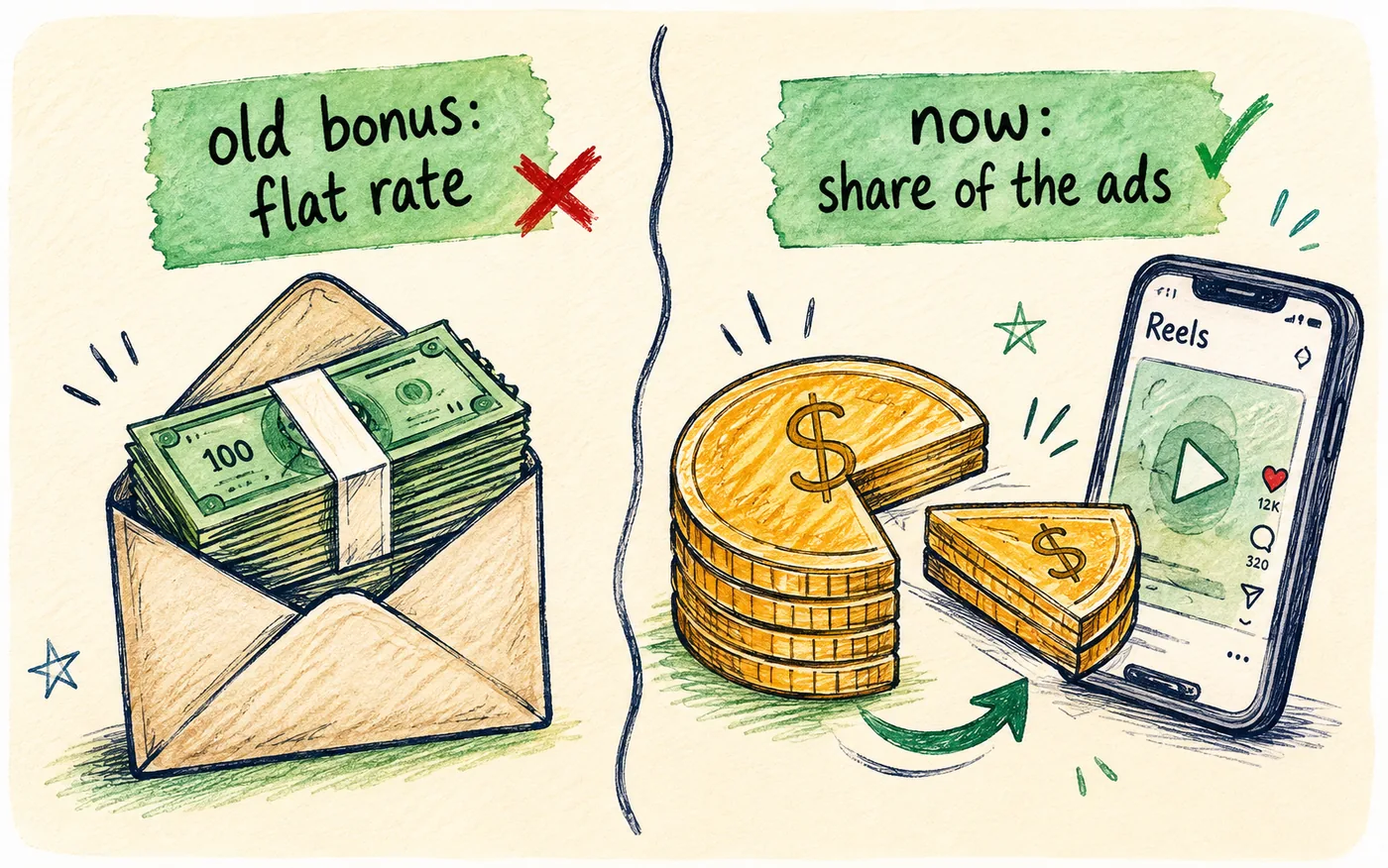
- Reels Play bonus (the old way): invite-only, paid flat amounts for hitting view milestones. Predictable, easy to write headlines about, and expensive for Meta to run at scale. It was wound down.
- Content Monetization (the current way): one program covering Reels, longer videos, photos and text posts. Ads run on and around what you publish, and you take a share of what those ads earn.
The switch cut both ways for creators. The old bonus was a fixed cheque that ignored who was watching, which suited creators with huge international reach and low commercial value. The new system rewards the opposite profile. If your Reels earnings dropped without your views dropping, this is almost always the reason.
What actually decides your RPM
RPM is revenue per thousand views, and on Facebook it's an output, not a setting. Five things move it, and only some of them are in your hands.
- Where your viewers live. Advertisers pay far more to reach the US, Canada, UK, Australia and Western Europe than they do for most other markets. This is the single biggest factor, and it isn't fair.
- Your niche. Finance, insurance, software, home improvement and health have advertisers with real budgets. Comedy, animals and general entertainment don't, no matter how big they get.
- Watch time. Longer Reels that hold attention create room for more ad impressions. A 12-second loop and a 55-second Reel with the same view count are not worth the same.
- The season. Ad rates climb through Q4 and fall off a cliff in January. The same Reel published in November and February earns noticeably different amounts.
- Originality. Reused, watermarked or lightly-edited content gets pulled out of monetization entirely, which takes your RPM to zero.
You can't move the first one much without changing who your content is for. You can move the other four this month. Start with watch time and originality, because they're the two that don't require you to abandon your niche.
Why two creators with the same views get different cheques
This is the part that generates the most confused posts in creator groups. One person reports $9 from 300,000 views. Another reports $340 from the same number. Both are telling the truth.
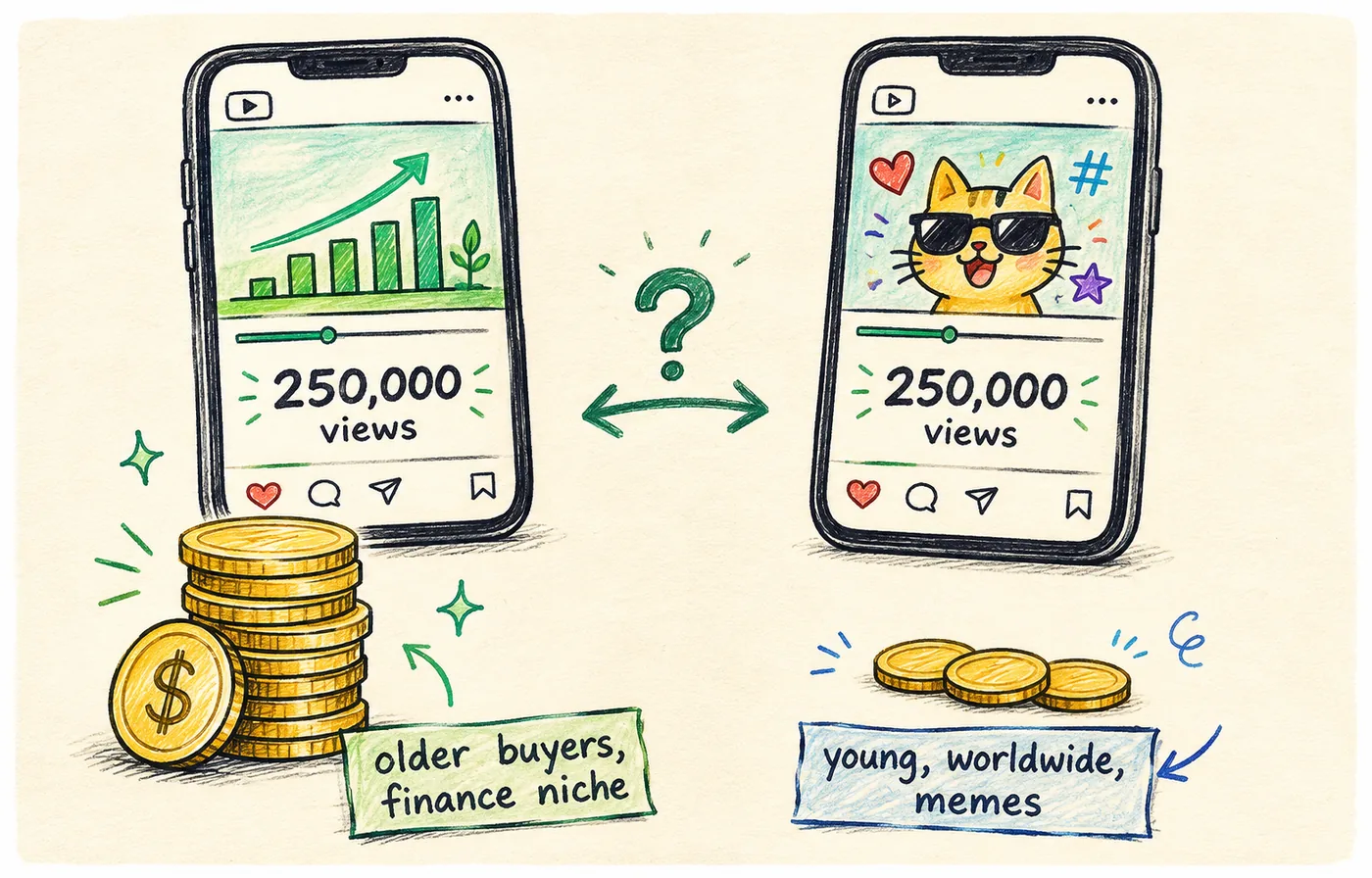
Facebook isn't paying you for views. It's paying you a cut of an auction that advertisers ran to reach the specific people who watched. When a mortgage broker bids to reach a 45-year-old homeowner in Ohio, the winning bid is large. When nobody in particular is bidding to reach a 19-year-old scrolling memes at 2am in a market with thin ad demand, the impression is worth a fraction of a cent.
| Audience profile | Rough Reels RPM | Why |
|---|---|---|
| US/UK, 35+, finance or home | $1 – $3 | Highest advertiser competition |
| US/UK, 18–34, lifestyle | $0.40 – $1.20 | Good market, softer niche |
| Mixed international, broad topic | $0.10 – $0.50 | Diluted ad value |
| Mostly low-CPM markets, memes | $0.01 – $0.10 | Almost no advertiser demand |
Read that table as a description of your audience, not a verdict on your content. Plenty of excellent creators sit in the bottom row, and plenty of dull ones sit at the top. It also explains why Facebook can quietly out-earn TikTok for some accounts while paying almost nothing for others, a pattern the platform comparison covers in more depth in which platform pays creators the most.
Do you qualify? The eligibility checklist
Before any of this pays out, you have to be accepted into content monetization. The exact thresholds shift by region and Meta adjusts them, so treat the list as the shape of the requirement rather than a fixed set of numbers.
- A Facebook Page or a profile in professional mode. A plain personal profile can't monetize.
- A follower threshold. Meta sets this per region and has been lowering it over time as the program opens up.
- Recent views or watch time. Historic totals don't count. It's a rolling window, usually measured over the last 60 days.
- An eligible country and age. Payouts aren't available everywhere, and you need to be 18 or over.
- A clean policy record. Community Standards strikes, monetization policy violations and repeated reported content all block approval.
- Original content. This is the one that quietly disqualifies the most people, and it's covered below.
Once you're in, monetization is per-Page, not per-video, but individual Reels can still be marked ineligible while the rest of your content earns normally. If posting itself is failing rather than just earning, that's a different problem with different causes, and the reasons Facebook blocks posts are worth ruling out first.
What Facebook won't pay you for
The originality rules are stricter than most creators assume, and they're enforced automatically. Getting caught by them doesn't usually generate an email. Your earnings just sit at zero while your views look fine.
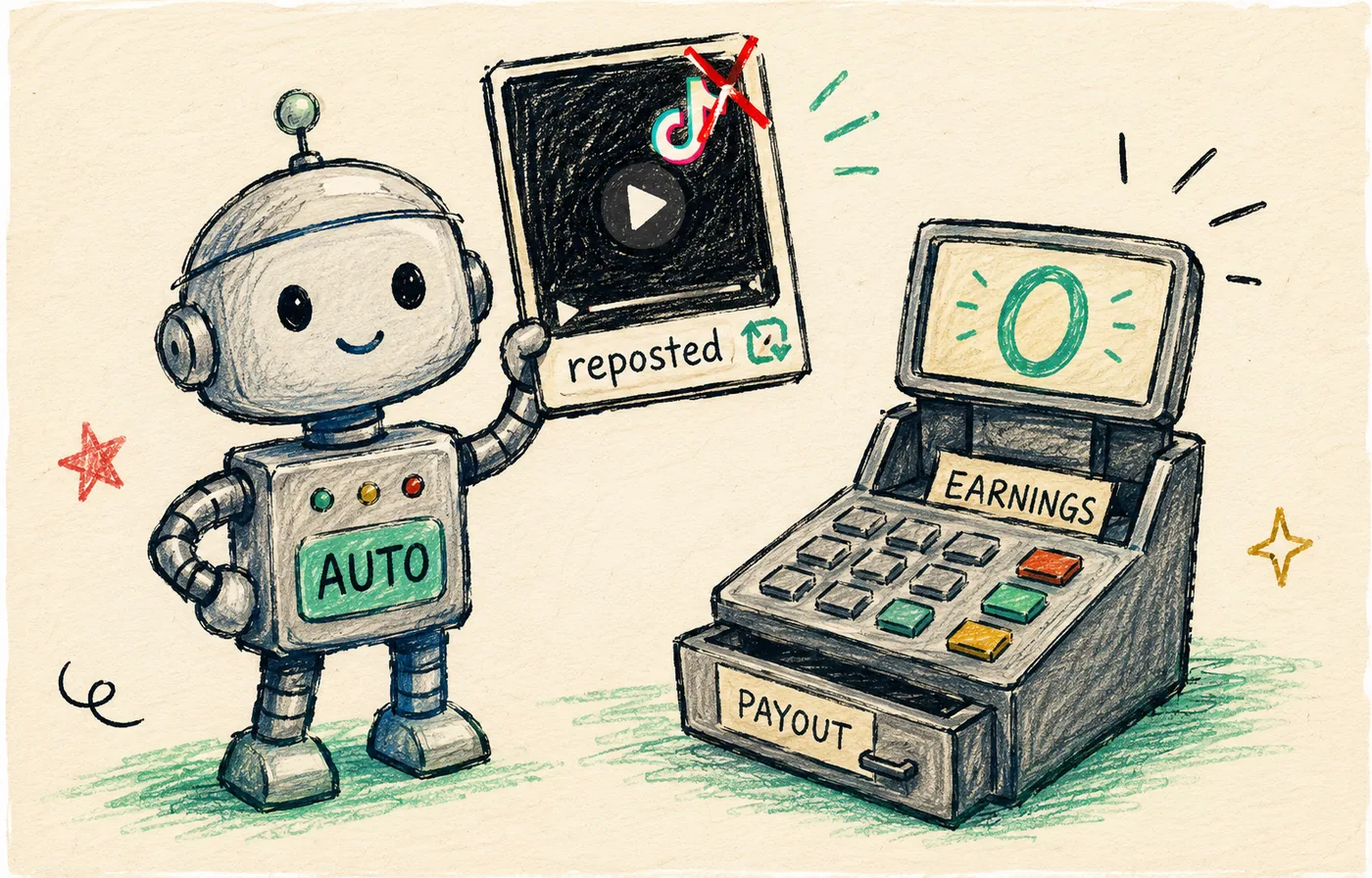
- Videos with another platform's watermark. Exporting straight from TikTok with the logo burned in is the classic way to earn nothing.
- Compilations and reposts of other people's clips, even with a caption bolted on.
- Static slideshows and low-effort text-over-stock content, which Meta classes as unoriginal.
- Engagement bait. "Type AMEN to continue" style posts are demoted and demonetized.
- Anything touching restricted topics, from tragedy and conflict to explicit or misleading content.
The fix for the watermark problem takes about ten seconds: export the clean file from your editor rather than downloading your own video back off another app. If you're moving clips between apps regularly, cross-posting from Instagram to TikTok and back walks through keeping a clean master file.
Facebook Reels vs TikTok, Shorts and Instagram
Short-form pay is bad across the board compared to long-form video, but the platforms are not equally bad, and Facebook sits higher than its reputation suggests.
| Platform | Rough pay per 1,000 views | Best for |
|---|---|---|
| Facebook Reels | $0.01 – $2+ | Older, higher-spending viewers |
| TikTok Creator Rewards | $0.40 – $1 (qualified views) | Fastest audience growth |
| YouTube Shorts | $0.01 – $0.06 | Funnelling to long-form |
| Instagram Reels | Mostly $0 direct | Brand deals and DMs |
| YouTube long-form | $1 – $5+ | Actual per-view income |
The pattern is that Facebook has the highest ceiling of the short-form four and the lowest floor. TikTok is more consistent but capped, as the breakdown of what TikTok pays for a million views shows in detail. Nothing short-form comes close to long-form YouTube per view, which is why YouTube's rate per 1,000 views is the benchmark everyone measures against.
Facebook is the most under-used short-form platform
Ask a creator under 30 about Facebook and you'll usually get a joke about their aunt. That reflex is exactly why the platform is worth your time. Competition for attention there is thinner than on TikTok, and the ad system paying for that attention is one of the most mature on the internet.
The demographic that makes Facebook uncool is the same demographic that makes it pay. Older users have more disposable income, click more ads, and buy more things, so advertisers bid harder for them. You don't have to make content for retirees to benefit. You just have to be present where those impressions are being sold.
The practical bar is low, too. The same 9:16 vertical file you already export for TikTok and Reels works on Facebook without a single change. There's no separate format, no separate edit, no extra shoot. Skipping it isn't a strategy, it's just a habit.
How to raise your Facebook Reels earnings
Since your pay is a share of ad revenue, growing it means growing the things advertisers actually pay for. In rough order of impact:
- 1Push your Reels past the 60-second mark when the content supports it. Longer watched Reels carry more ad impressions, and the difference in RPM is not subtle.
- 2Front-load the hook. Completion rate drives both distribution and ad load, so the first second decides the paycheque as much as the view count.
- 3Keep every upload original and watermark-free. One reused clip won't kill your Page, but a habit of them will quietly cap your whole account.
- 4Lean into the commercially valuable end of your niche where it's honest. A home-cooking creator doing a kitchen-tools Reel earns more than the same creator doing a meme, from fewer views.
- 5Post consistently rather than in bursts. Facebook rewards regular publishing with steadier distribution, and steadier distribution smooths out your earnings.
- 6Publish when your audience is actually awake, because early watch time shapes how far a Reel travels. The platform-by-platform breakdown of the best time to post on social media has the specifics.
What won't help: obsessing over hashtags, deleting underperforming Reels, or reposting old winners hoping the algorithm forgot. None of those touch ad revenue.
How Facebook fits into a cross-posting stack
Treating Facebook as a separate project is what makes it feel not worth the effort. Treating it as one more destination for a clip you already made changes the maths completely, because the marginal cost of adding it is close to zero.
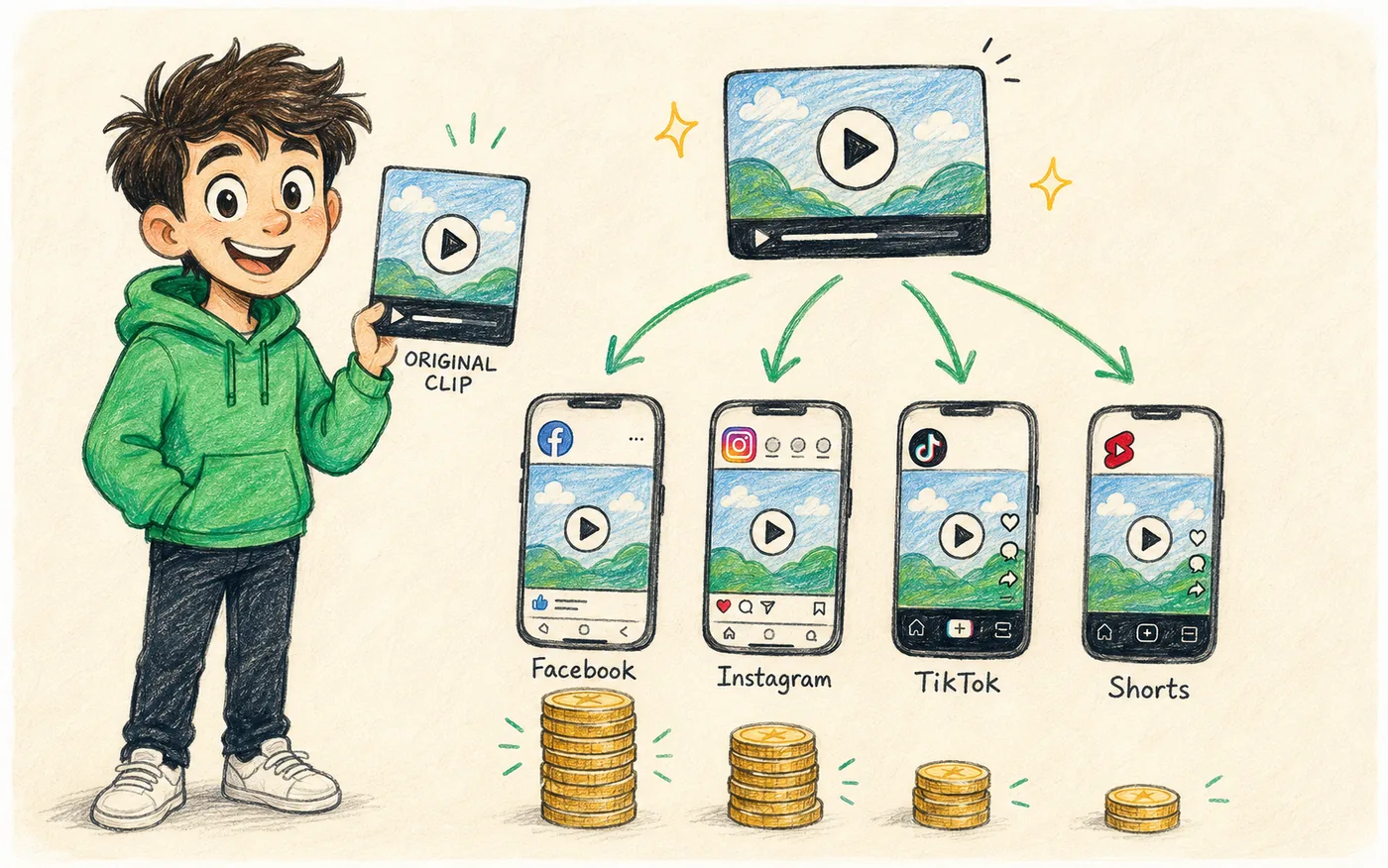
The workflow most creators settle on is one master edit per clip, uploaded once, distributed to Facebook, Instagram, TikTok, YouTube Shorts and anywhere else they're active. Each platform pays what it pays. Nobody has to guess in advance which one will carry the month, which is the entire point, and it's the core argument behind posting the same content everywhere at once.
Done by hand, that's an hour of app-switching per clip and you'll stop by week three. Done through a scheduler, it's the same upload you were already doing with four more boxes ticked. That difference in friction is what decides whether Facebook ever gets a fair test on your account.
Post one Reel to Facebook, Instagram, TikTok and Shorts at once with Crossposting.
Try it freeGetting paid: thresholds and timing
Earning and receiving are different steps, and the gap between them surprises people who watch a balance climb for weeks with nothing landing in their bank.
- A minimum payout threshold applies, historically around $100. Below it, your balance rolls over to the next month instead of paying out.
- Payouts run on a monthly cycle, typically around three weeks after the month closes, so your January earnings arrive well into February.
- You need a payout account and tax details on file before anything moves. Half the "Facebook didn't pay me" posts are an incomplete payout setup.
- Earnings can be clawed back for invalid traffic or policy violations found after the fact.
Check your Professional Dashboard rather than trusting a third-party estimate. The estimated earnings figure updates through the month and settles at the end, so mid-month numbers move around more than you'd expect.
When Facebook Reels are worth it, and when they aren't
Honest position: if your audience is mostly teenagers outside high-CPM markets, Facebook ad share will not become meaningful income for you, and pretending otherwise wastes your planning time. Post there anyway for reach, but count the money elsewhere.
If your content touches money, home, health, family, food, travel or anything people buy, Facebook deserves a real three-month test with consistent posting. That's the profile where creators discover their least-cool platform is quietly their best-paying one per view.
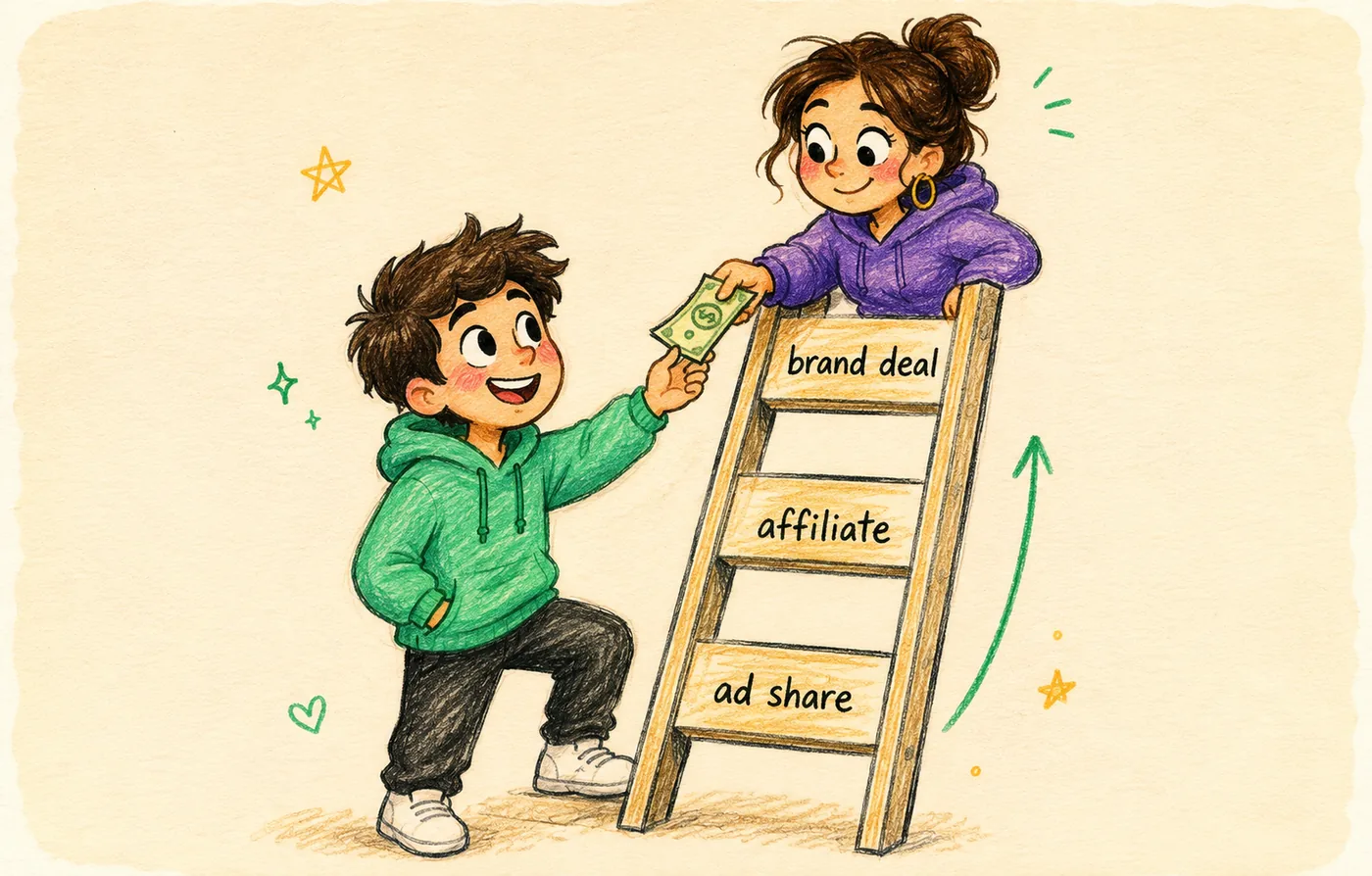
Ad share is a floor, not a plan. The creators earning real money on Facebook use the reach to sell something.
Either way, don't build your income on ad revenue alone. Layer affiliate links, sponsorships and your own products on top, and the reach becomes a funnel instead of a payout. Where each platform sits on that ladder is the whole subject of which platform pays creators the most.
Reels or longer video? Facebook pays both differently
Content monetization covers your whole Page, but the formats don't earn at the same rate. Longer horizontal video carries in-stream ads, which are worth more per viewer than the ads sprinkled through the Reels feed. Reels win on reach, longer video wins on RPM, and the two feed each other.
| Format | Relative RPM | What it's good at |
|---|---|---|
| Reels (under 60s) | Lowest | Cheap reach, new followers |
| Reels (60s – 3 min) | Middle | The sweet spot for most creators |
| Video (3 min+) | Highest | In-stream ads, loyal viewers |
| Photos and text posts | Low but real | Filling quiet days |
The practical read: if your topic can hold someone for 90 seconds, don't cut it to 25 for the sake of a trend. On Facebook specifically, the longer version usually earns more even when it gets fewer views. That's the opposite of the advice TikTok trained everyone on, and it catches a lot of creators out.
A realistic first ninety days
Expectations are where most Facebook attempts die. People add the platform, watch it earn $3 in a month, and quit before the data means anything. Here's what a normal ramp actually looks like when you post consistently.
Month one is noise. Distribution is unstable while Facebook works out who to show you to, so view counts swing from 200 to 40,000 with no obvious pattern and your earnings are effectively a rounding error. Nothing you read in that month is a signal. Keep publishing and ignore the dashboard.
Month two is where the audience profile starts to show. You'll see which countries your viewers come from and which Reels hold attention, and your RPM will settle into a band you can recognise. This is the first point where the numbers in this guide are useful for comparison, because now you know which column of that first table you're in.
Month three is the decision point. By then you know your rough RPM, so multiply it by the reach you can sustainably produce and you have an honest annual figure. If that number is worth a slot in your week, commit properly and start layering products and deals on top. If it isn't, keep cross-posting to Facebook anyway for the free reach and stop counting on the ad share. Either answer is a good outcome, and the same ninety-day logic applies when you repurpose one video into ten posts across the rest of your platforms.
Frequently asked questions
How much does Facebook Reels pay per 1,000 views?
Roughly $0.01 to $2 per 1,000 views. Facebook shares ad revenue instead of paying a flat rate, so a US-heavy audience in a commercial niche lands near the top of that range while a broad international audience earns cents. Your Professional Dashboard shows your actual rate.
Does Facebook still pay a Reels bonus?
No. The invite-only Reels Play bonus has been wound down. Facebook now pays through Content Monetization, a single program covering Reels, video, photos and text, where ads run on your content and you take a share of the revenue they earn.
How do I get my Facebook Reels monetized?
You need a Page or a profile in professional mode, must meet Meta's follower and recent-view thresholds for your region, be 18 or over in an eligible country, have a clean policy record, and post original content. You apply through content monetization in your Professional Dashboard.
Do Facebook Reels pay more than TikTok?
Sometimes, and by a lot. Facebook has the higher ceiling because its ad system is mature and its audience skews older and higher-spending, but it also has the lower floor. TikTok's Creator Rewards are more consistent per qualified view. Post to both and compare your own dashboards.
Why are my Facebook Reels earnings so low with lots of views?
Almost always the audience mix. If your viewers are mostly in low-CPM markets or your niche has few advertisers bidding, hundreds of thousands of views can pay single-digit dollars. Short Reels with low completion rates also carry fewer ad impressions, which compounds it.
When does Facebook actually pay you?
Payouts run monthly, usually around three weeks after the month ends, and only once you pass the minimum threshold, historically about $100. Below the threshold, your balance rolls forward. You also need a payout method and tax details on file before anything is sent.
Bottom line
Facebook Reels pay a share of ad revenue, so "per 1,000 views" honestly ranges from a cent to a couple of dollars depending almost entirely on who's watching. Qualify for content monetization, keep every upload original and watermark-free, push watch time, and stop assuming the platform is only for older relatives. For a large slice of niches, it's the best-paying short-form surface there is.
The cheapest way to find out where you land is to stop making Facebook a separate job. Make the clip once, send it everywhere, and read the dashboards after ninety days. Try Crossposting free.
Put this into practice
Schedule a week of content to every platform in one sitting. Free to start, no card today.
Try Crossposting free