Cross-Posting Without Getting Flagged as Spam or Shadowbanned
Cross-posting doesn't cause shadowbans. These specific habits do. Here's how to post everywhere and stay safe.
The Crossposting Team
Crossposting.xyz
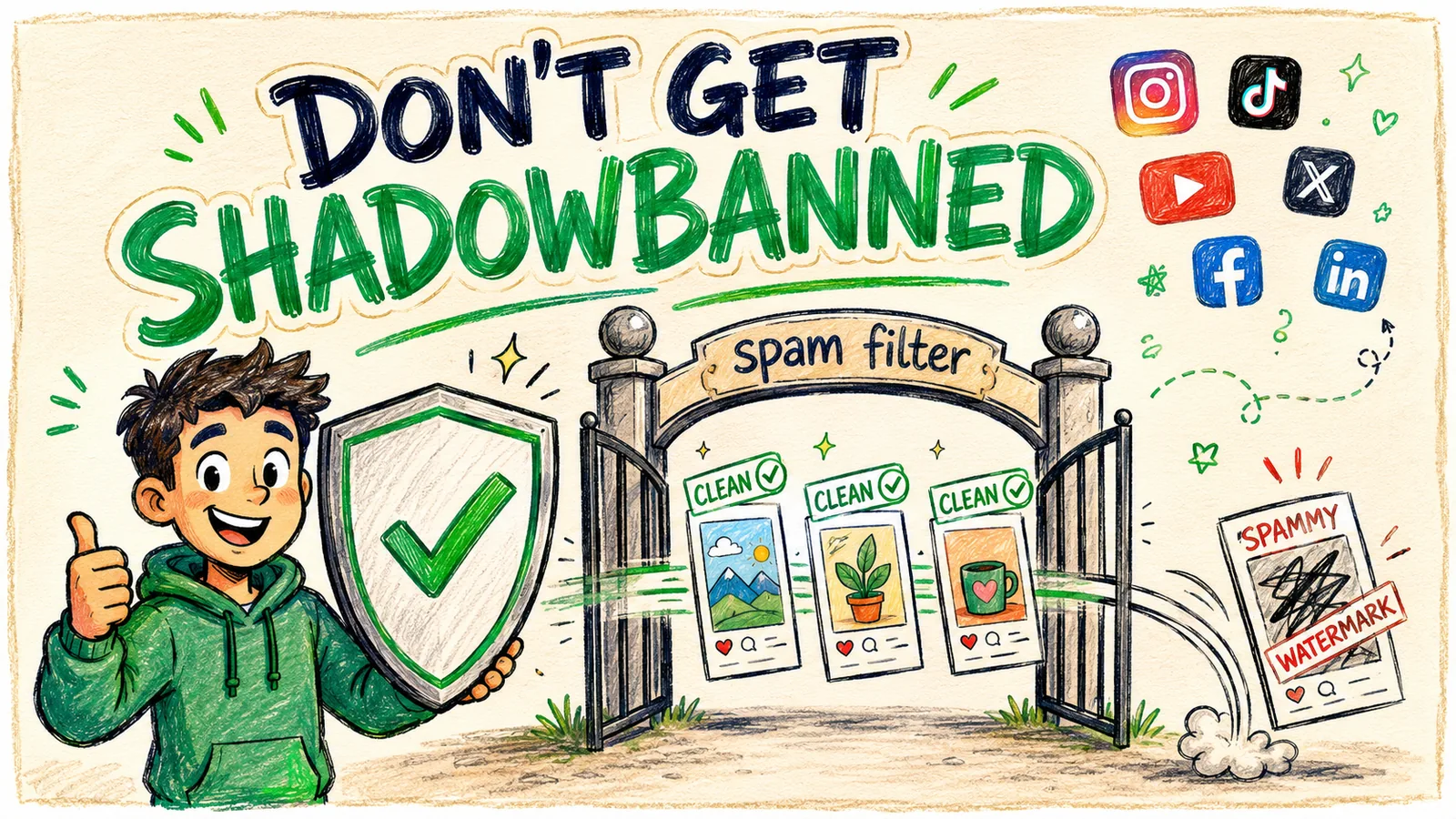
Cross-posting does not get you shadowbanned. Publishing the same idea to TikTok, Instagram, YouTube, X and more is normal and safe, because each platform is a separate audience. What triggers spam filters is a short list of specific habits: watermarked files, identical posts to multiple accounts on one platform, link-sharing between apps, and instant identical blasts. Avoid those and you can post everywhere with zero risk.
This guide covers exactly what causes flags, the eight rules that keep you safe, and how to recover if you're already throttled.
What a shadowban actually is
A shadowban is when a platform quietly limits how many people see your content without telling you. Your posts still exist, but they stop appearing on the For You page, under hashtags, or in search. There's no notification, which is why it feels mysterious. The tell is a sudden drop in reach across every post at once, not just one weak video.
Shadowbans are almost always behavioral. The platform's spam system saw a pattern that looked automated or manipulative and pulled back your distribution as a precaution. Fix the behavior and reach usually returns within days to two weeks.
What actually triggers a flag (and what doesn't)
Let's separate the real triggers from the myths, because most "cross-posting caused my shadowban" stories are misdiagnosed.
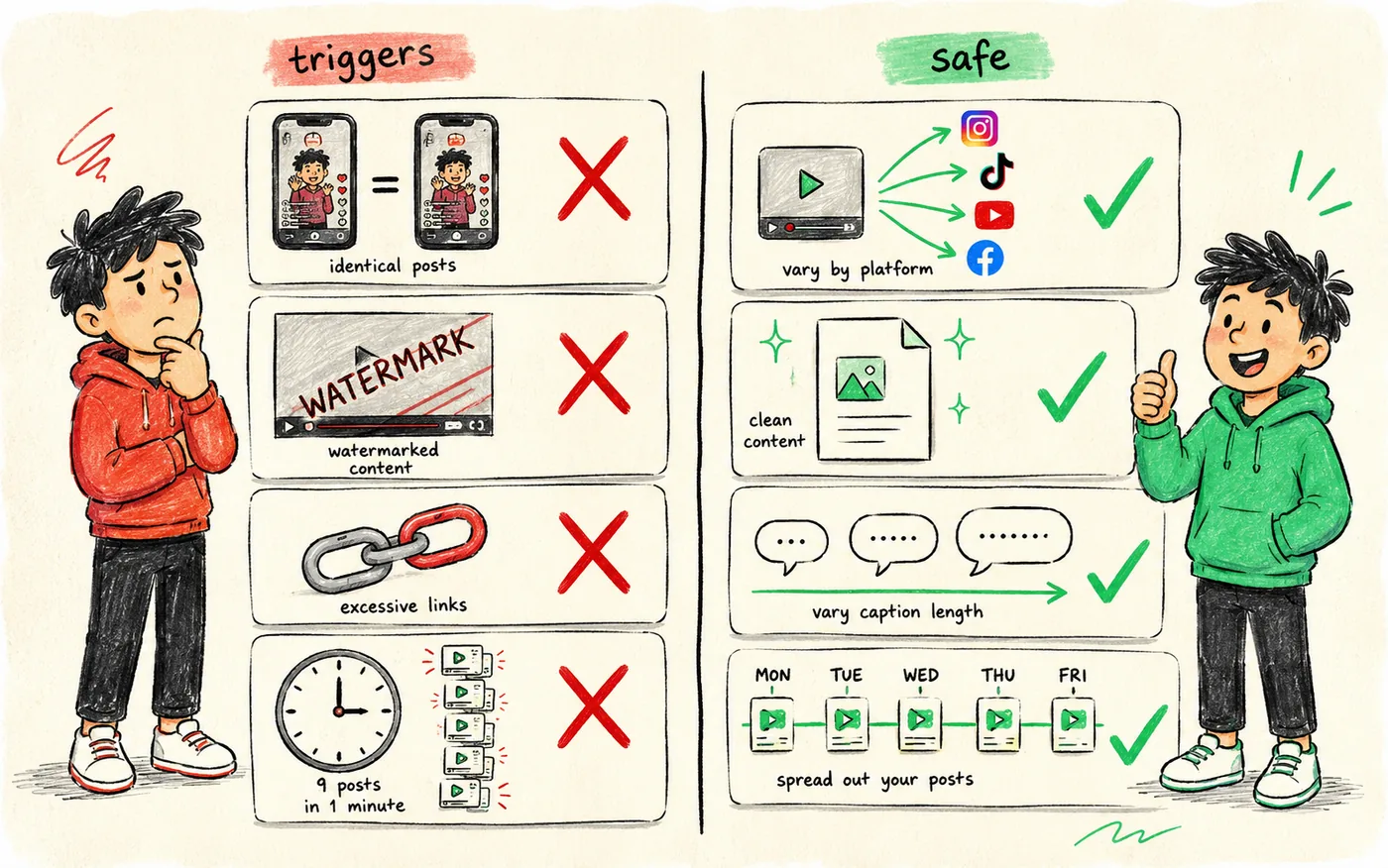
| Habit | Flag risk | Why |
|---|---|---|
| Same idea to different platforms | None | Each platform is a separate audience |
| Same post to multiple accounts, same platform | High | Classic spam/bot pattern |
| Competitor watermark on the file | High | Platforms down-rank foreign branding |
| Link to another app instead of a file | Medium | Off-platform links get suppressed |
| All nine posts in the same minute | Medium | Looks automated |
| Banned or irrelevant hashtags | Medium | Trips content filters |
The 8 rules for safe cross-posting
Follow these and you can publish to every platform, every day, without a single flag.
1. Upload native files, never links
Export a clean file from your editor and upload it directly to each platform. A link to your TikTok posted on X gets suppressed, because platforms don't want to send people away.
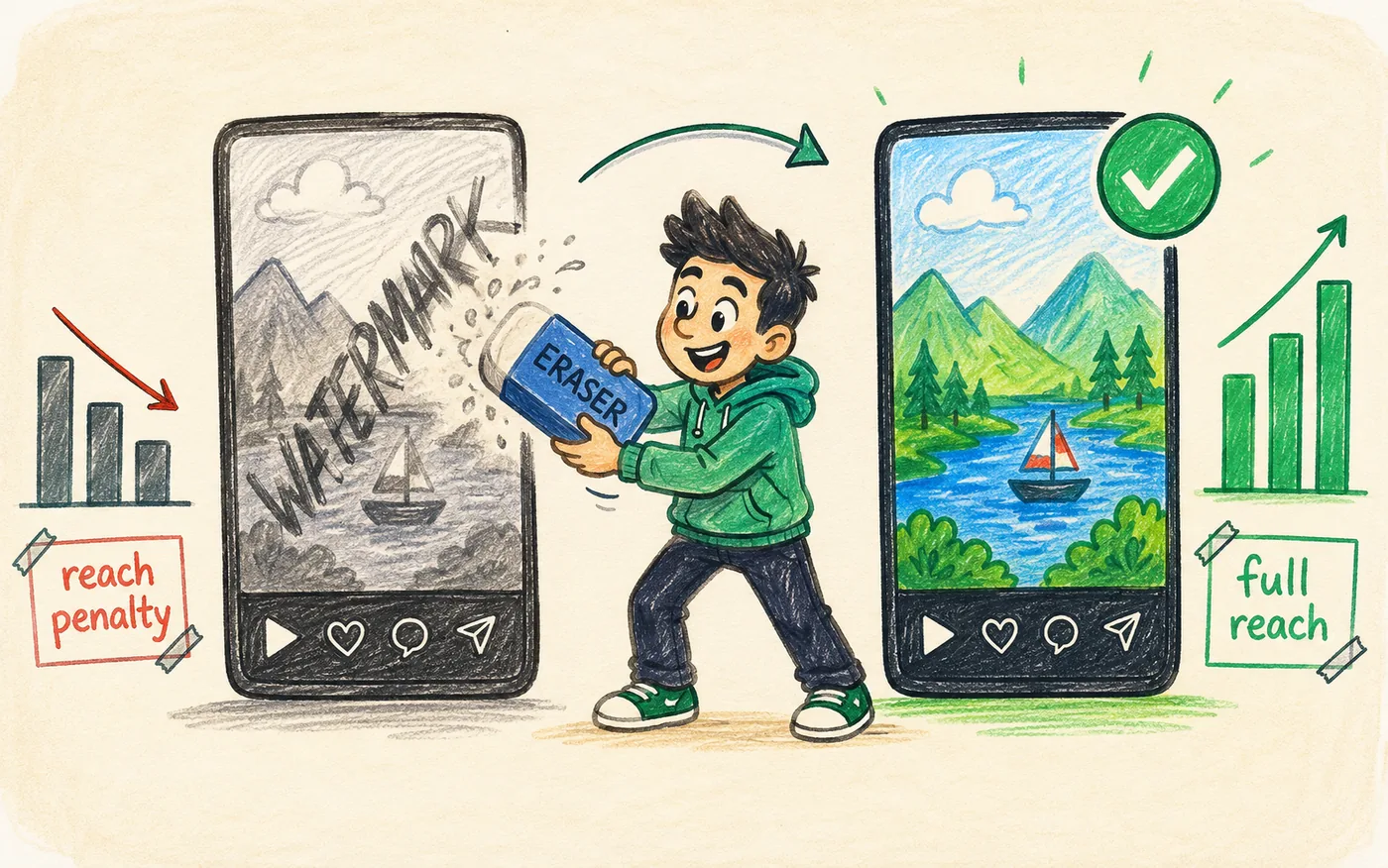
2. Remove every watermark
The most common self-inflicted penalty. Downloading a TikTok with the logo and posting it to Reels tells Instagram your content is second-hand. Always use the clean export.
3. Never duplicate to multiple accounts on the same platform
Two of your own Instagram accounts posting the same Reel is the single fastest way to a shadowban. Cross-platform is safe; same-platform duplication is not.
4. Vary your captions and hashtags
Keep the idea identical but change the wrapper. Different caption length, different hashtags, different call to action per platform. Identical text everywhere reads as a bot.
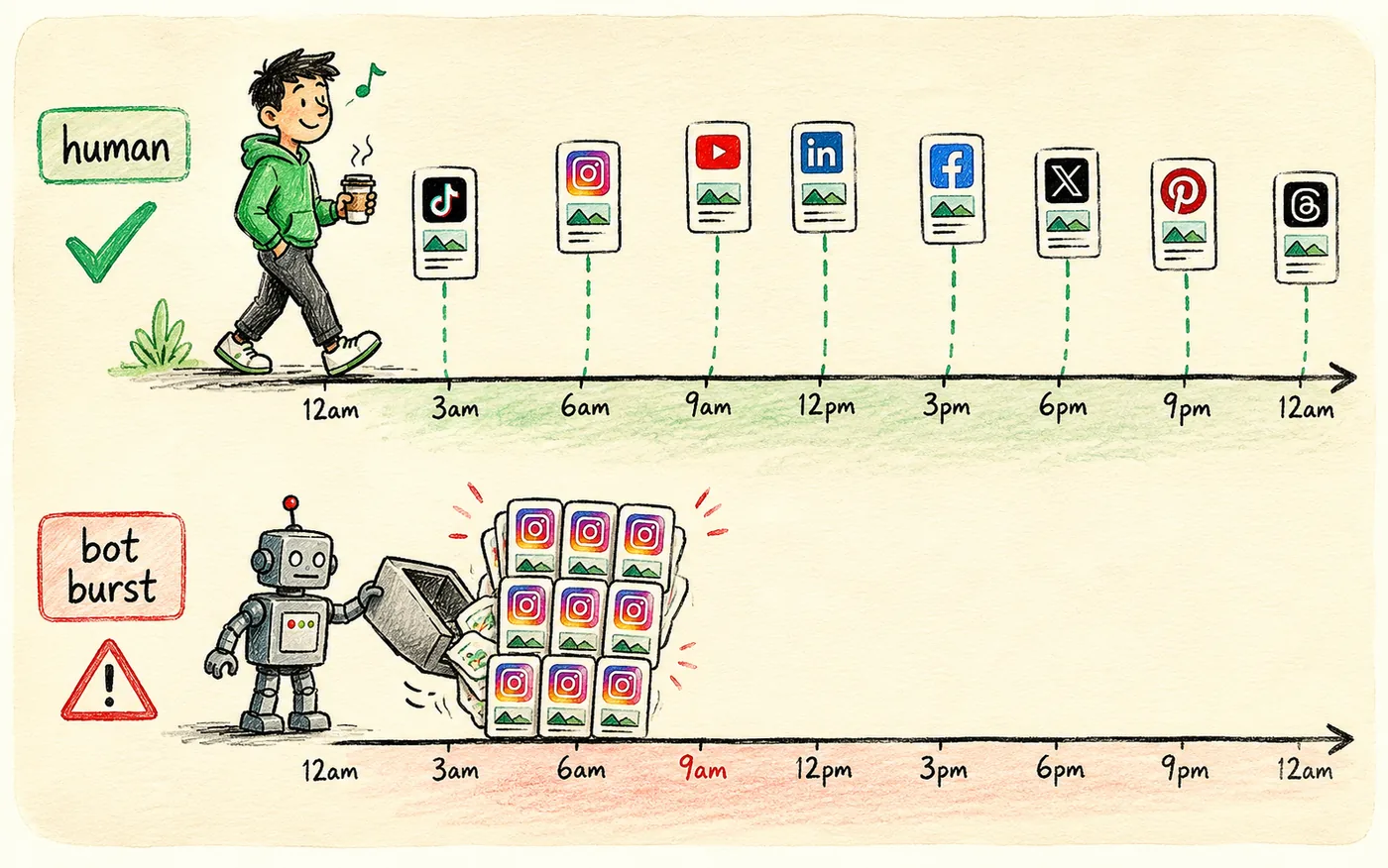
5. Stagger your posting times
Don't fire all nine posts in the same 60 seconds. Space them across the day. A scheduler does this automatically and hits each platform's best time while it's at it.
6. Warm up new accounts
A brand-new account that immediately posts four times a day looks like a bot. New accounts need a week of profile setup and manual engagement before ramping. Full routine in the FAQ below.
7. Skip banned and generic hashtags
Some hashtags are quietly banned and can suppress a whole post. Use 3–5 specific, relevant tags instead of 30 generic ones. Generic spam tags do nothing and can hurt.
8. Use official APIs, not sketchy automation
Reputable cross-posting tools publish through each platform's official API, which is exactly how the platforms want third-party apps to post. Grey-market bots that automate the app itself are what get accounts flagged. Pick tools that are official partners.
Crossposting publishes through official APIs — native, staggered, and safe by design.
Try it freeHow to recover if you're already shadowbanned
If your reach dropped across every post, run this reset.
- 1Stop posting for 48–72 hours. Let the flag cool down.
- 2Delete the offenders: any watermarked files, duplicate posts, and banned hashtags.
- 3Engage manually like a normal user during the pause — watch, comment, like in your niche.
- 4Resume at one native post a day and rebuild from there.
If it's TikTok specifically and you're not sure whether it's a shadowban or just a weak video, diagnose it with why your TikTok isn't getting views.
How to tell a shadowban from a normal dip
Not every quiet week is a shadowban. Panicking and changing everything after one slow post does more harm than a real flag would. Here's how to tell them apart before you hit the reset button.
| Signal | Normal dip | Actual shadowban |
|---|---|---|
| Which posts affected | One or two | Every post at once |
| View counts | Low but not zero | Near zero |
| Hashtag pages | Still appear | Don't appear |
| Search visibility | Findable | Missing |
| Timing | Random | Started after a specific action |
If only one video underperformed, that's content variance — make more and move on. If every post cratered at once and you vanished from hashtags and search, that's a flag worth resetting. The account-wide pattern is the tell.
Three tests that tell you for sure
Before you reset anything, confirm the flag actually exists. These three checks take about five minutes and beat guessing from a bad week of numbers.
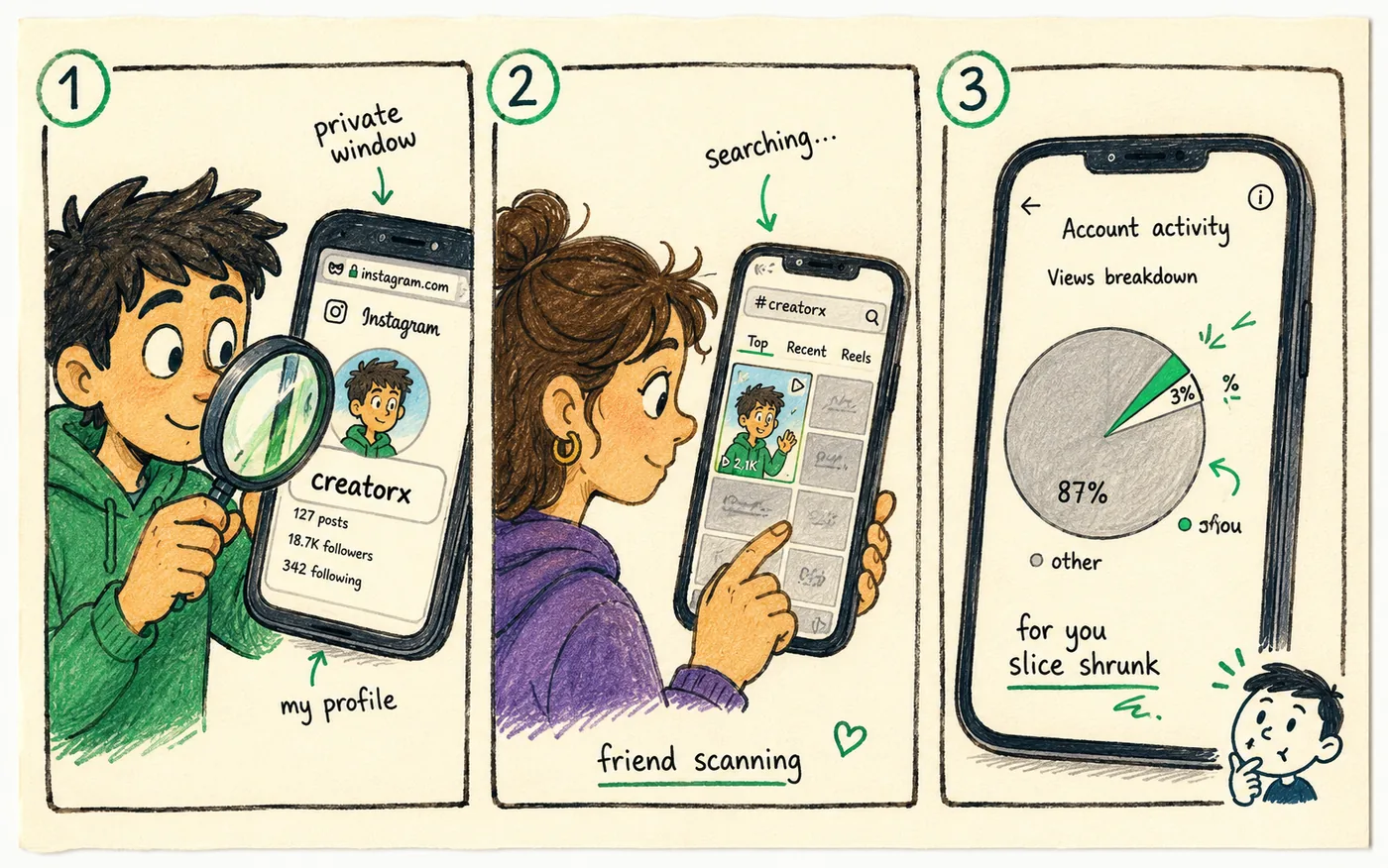
Test 1: the logged-out search
Open the platform in a private browser window or on a phone that isn't logged into your account, then search your exact handle. If your profile doesn't appear at all, you're likely search-restricted. If it appears normally, your account is visible and the problem is content, not distribution.
Test 2: the hashtag check with an outsider
Post using one specific, low-volume hashtag — something niche enough that your post should be near the top. Then ask someone who doesn't follow you to open that hashtag page and look for it. Followers often still see your posts during a shadowban, which is exactly why creators misdiagnose it. A non-follower is the honest test.
Test 3: your own traffic sources
This is the most reliable one, and most people never look. Every platform tells you where your views came from.
- TikTok: post analytics show a traffic-source breakdown. Healthy videos get most views from the For You feed. If "For You" collapses to a tiny share while "Following" and "Personal profile" carry everything, distribution was cut.
- Instagram: check Account Status in settings — it tells you directly whether your content is eligible to be recommended to non-followers. Reels insights also split followers vs non-followers.
- YouTube: the traffic source report shows whether Shorts feed impressions dried up or just underperformed.
If Account Status is clean and your For You share is normal, you're not shadowbanned — the content just didn't land. That's a completely different problem with a completely different fix, and it's worth knowing which one you have before you delete anything.
Four shadowban myths worth ignoring
This topic attracts more folklore than almost anything else in social media. These four come up constantly and none of them hold up.
| The myth | What's actually true |
|---|---|
| "Posting too often gets you banned" | Frequency alone is fine. Sudden floods from a brand-new account are the risk, not volume from an established one |
| "Delete the post and repost it" | Deleting and reposting the same file looks more like manipulation, not less. It rarely helps and often hurts |
| "Certain words get you banned" | Ordinary words don't. Banned hashtags are real, but a normal caption isn't a trigger |
| "You need a fresh account" | New accounts start with less trust, not more. Fixing the behavior on your existing account is faster than rebuilding |
The reason these myths spread is that reach is noisy. A creator changes five things during a slow week, reach recovers on its own, and whichever change they believed in gets the credit. Trust the tests above over the folklore.
Platform-specific triggers to know
The core rules are universal, but each platform has its own sensitivities worth knowing if you cross-post to all of them.
- Instagram: the watermark penalty is the big one. Reused TikTok clips with the logo are the most common self-inflicted flag. Check Account Status for restrictions.
- TikTok: banned hashtags and posting too fast on a new account. Near-zero views across the board is the classic sign.
- X: aggressive automation, identical replies, and mass-following. X also limits reach on posts with external links.
- LinkedIn: engagement pods and reposting without commentary get down-ranked. LinkedIn is stricter about anything that looks like coordinated gaming.
- Facebook: shortened or flagged links and rapid duplicate posts across groups trigger blocks fast.
The pattern across all of them: they're not punishing cross-posting. They're punishing behavior that looks automated, reused, or manipulative. Post native, clean, and human, and none of these fire.
Can a shadowban hit all your platforms at once?
No, and this is one of the quiet advantages of cross-posting that nobody mentions. Flags are per-platform. TikTok's spam system doesn't talk to Instagram's, and neither of them tells YouTube anything. A restriction on one account has no effect on the other eight.
So if your reach dropped on every platform in the same week, a shadowban is almost certainly not the explanation. Far more likely: the content itself underperformed, or it's a seasonal lull — holidays, big news events and major sports finals all flatten organic reach across the board. Nine platforms don't coordinate a punishment against you on the same Tuesday.
That's also the practical case for being on more than one platform. When one account genuinely does get throttled, the other eight keep running and your audience doesn't disappear while you wait it out. A single-platform creator in the same situation has nothing.
Building a safe cross-posting routine
The best defense against shadowbans isn't a recovery plan — it's a routine that never triggers one. Bake these habits in and you'll rarely think about flags again.
- 1Export clean master files from your editor and save them before posting anywhere.
- 2Write varied captions per platform as part of your workflow, not an afterthought.
- 3Schedule with staggered times so nothing fires in an identical burst.
- 4Use one official-API tool instead of grey-market bots.
- 5Keep a steady, human cadence — one to a few posts a day, not sudden floods.
Frequently asked questions
Does cross-posting cause a shadowban?
No. Posting the same idea to different platforms is safe because each is a separate audience. Shadowbans come from specific habits: watermarked files, duplicate posts to multiple accounts on the same platform, cross-app links, and instant identical blasts.
How do I warm up a new account before cross-posting?
Days 1–2: complete the profile and follow relevant accounts, don't post. Days 3–4: engage manually (comment, like) in your niche. Days 5–7: post once a day natively. Week 2 onward: ramp to your real cadence of one to a few posts a day.
How do I check if I'm shadowbanned?
Three checks: search your handle from a logged-out browser to see if your profile is findable; post with one specific niche hashtag and ask a non-follower to look for it on that hashtag page; and check your own analytics for traffic sources — if TikTok's For You share collapsed or Instagram's Account Status flags a restriction, distribution was cut. If all three look normal, the content underperformed rather than the account being flagged.
Should I delete a post if I think it got me flagged?
Only if it genuinely breaks a rule — a watermarked file, a banned hashtag, or a duplicate of something on another of your accounts. Deleting and reposting normal content doesn't lift a flag and can look like manipulation. Pause, clean up the actual offenders, then resume posting slowly.
How long does a shadowban last?
Usually a few days to two weeks once you stop the triggering behavior. Pause posting for 48–72 hours, remove watermarked or duplicate content and banned hashtags, engage normally, then resume slowly.
Is it safe to use a cross-posting tool?
Yes, if it publishes through each platform's official API — that's how platforms intend third-party apps to post. Avoid grey-market bots that automate the app itself, since those are what get accounts flagged.
Bottom line
Cross-posting is not the enemy of your reach. Watermarks, same-platform duplicates, cross-app links, and instant identical blasts are. Upload clean native files, adapt your captions, stagger your timing, and use tools that post through official APIs. Do that, and you can be on every platform without ever meeting the spam filter.
Want cross-posting that's safe by default? Start free.
Put this into practice
Schedule a week of content to every platform in one sitting. Free to start, no card today.
Try Crossposting free